
Missouri Probate Division Cases
Probate is not a separate tier of Missouri courts. It is a division of the Circuit Court. Each county and the independent City of St. Louis provides probate jurisdiction, although local rules may assign work to a judge, commissioner, associate circuit division, or specialized clerk counter. Venue often follows a deceased person's domicile for an estate or a ward's or protectee's residence for guardianship, subject to Missouri law.
Missouri probate files include wills, applications to admit or reject wills, letters, bonds, inventories, creditor claims, sale requests, settlements, distributions, and discharge orders. Shorter procedures can include refusal of letters, a small-estate affidavit, heirship, or a foreign personal representative. Guardianship concerns personal decisions. Conservatorship concerns property and finances. One or both may be ordered.
Missouri Probate Terms Defined
These terms identify the people, authority, and procedures found in a Missouri probate docket.
- Testator
- The person who made a will.
- Personal representative
- The person appointed to administer the estate. An executor is a representative nominated in a will.
- Intestate
- Dying without an admitted valid will, so Missouri succession law controls distribution.
- Letters
- The current court-issued proof that authorizes a personal representative, guardian, or conservator to act within stated limits.
- Guardianship
- Court-supervised authority over personal care or decisions.
- Conservatorship
- Court-supervised authority over property and finances.
- Inventory
- The filed list of estate assets and values, subject to access and redaction rules.
A guardian does not automatically control every financial matter, and a conservator does not automatically control every personal choice. Read the current letters and underlying order for the actual grant of authority.
Search Missouri Probate Records
Begin with Missouri Case.net. Search a decedent or ward name, case number, and filing jurisdiction. Probate case codes and party roles can be less familiar than plaintiff and defendant labels. A public result may identify the file but withhold the desired document from remote access. A courthouse terminal or Probate Clerk request can expose additional public material allowed under judicial rules.
- Identify the likely venue from domicile, residence, property, or known court papers.
- Search Case.net by full name and narrow by filing jurisdiction or case type.
- Review filing dates, testate or intestate clues, letters, claims, settlements, and closing events.
- Ask the Probate Clerk about a deposited will, old file, missing image, or confidential guardianship item.
- Order the exact plain or certified document needed and confirm the current fee.
Older Missouri estates can predate electronic indexing. Give the clerk or official archive the full name, approximate death year, residence, and any known probate book, packet, or case reference. Ask whether certification is available when the copy will be used as legal proof.
Historical research may require will books, probate packets, index volumes, microfilm, or transferred Missouri State Archives holdings. The archival image can support genealogy, but the present custodian decides whether it can certify a copy. For a property question, also inspect official deed records because a probate order and the later recorded conveyance answer different parts of the title history.
Missouri Probate Record Contents
A visible estate record can identify the cause number, Probate Division, case type, filing and closing dates, decedent, death date where public, personal representative, attorney, administration type, and judge or commissioner. It may show whether a will was filed or admitted, when letters issued, and whether bond was required. Heirs, devisees, interested parties, notices, claims, distributions, and discharge can appear in the index or documents.
Inventory details, account numbers, medical evidence, Social Security numbers, and protected guardianship facts may be redacted or withheld. Downloadable pleadings depend on remote-access rules. A docket entry proving that an inventory was filed is not the same as the inventory itself. Likewise, an old application does not prove that a representative's authority remains current.
Proof matters: Request current certified letters for authority, the admitted will plus admitting order for testamentary proof, and the final settlement and discharge to establish closing.
Missouri Estate Administration Process
The sequence depends on the estate and court orders, but the research supports a common Missouri path.
- Locate the original will and death certificate, then identify domicile, property, family, and urgent needs.
- File for probate of the will and letters, or seek letters of administration if there is no will.
- Qualify the representative and obtain letters. Bond may apply unless waived or otherwise excused.
- Give required notice, safeguard assets, file inventory, and evaluate creditor claims.
- Pay valid expenses, claims, taxes, and allowances in the proper order.
- File settlement or accounting, distribute property, obtain receipts, and seek discharge.
Independent administration reduces routine court oversight when authorized. Supervised administration requires more approvals. A small-estate or refusal-of-letters process may shorten some work but does not erase title, creditor, waiting, or notice requirements. Missouri thresholds have changed, so use current section 473.097 and the local checklist rather than an old web figure.
Missouri Probate Filing Fees
Missouri probate costs are not one statewide flat price. Local schedules combine statutory components, deposits, and case-specific charges. The following official circuit examples show the range documented in the research, not guaranteed prices for another jurisdiction. Publication, service, bond, appraisal, value-based assessments, certified copies, tax work, recording, and attorney compensation can add substantial costs.
| Probate Item | Official Local Example | Qualification |
|---|---|---|
| Will safekeeping | $3 | 32nd Circuit example |
| Refusal of letters or simple application | $68.50 | 32nd Circuit example |
| Small estate with will | $103.50 | Publication may be extra |
| Full estate without will | $148.50 | Butler County example |
| Full estate with will | $183.50 | Butler County example |
| Plain copies | Examples from $0.25 to $1 per page | Certification charges may be added |
Ask the local Probate Division for its current checklist, filing deposit, accepted payee, publication newspaper, service amount, and certified-copy quote before mailing payment. A filing deposit is only the start.
Use Missouri Probate Records
The correct document depends on the task. To prove present authority, request certified letters and verify that they remain effective. To prove a will, get the admitted will and order admitting it, not just a will left for safekeeping. To trace real property, combine the inventory and court orders with Recorder of Deeds instruments. To evaluate claims, inspect the claim docket, individual claims, rulings, and settlement.
To establish closing, obtain the final settlement, receipts, distribution or discharge order, and any reopening entry. Guardianship authority should be shown by current letters, orders, and listed limits. Public summaries should not repeat medical diagnoses or other sensitive evidence from an authorized file.
Restricted Missouri Probate Records
Public index access does not make every probate document public online. Medical and capacity evaluations, full account identifiers, Social Security numbers, protected addresses, sealed documents, and sensitive guardianship details can be restricted. Remote access may be narrower than inspection at a courthouse terminal. A person entitled to a restricted item may need identification, party status, counsel credentials, or a court order.
A narrow request helps the clerk segregate releasable material. State the cause number, party or estate name, exact document, preferred format, and whether certification is required. For administrative probate records outside the case file, a custodian request may apply. It does not override judicial confidentiality.
Probate timing depends on notice, creditor claims, taxes, disputed wills, unknown heirs, property sales, litigation, and missing accountings. Publication and service periods can extend a case. A small-estate affidavit may reduce procedure without removing every waiting period or claim risk. Use current Missouri law, court orders, and the local filing checklist for any deadline that can affect rights.
Note: Missouri probate deadlines can bar rights, so never rely on a general promise that every estate closes within a fixed number of months.
Missouri Probate and Bankruptcy
Probate and bankruptcy are separate systems. Probate distributes a deceased person's estate under state law and Circuit Court orders. Bankruptcy is a federal proceeding that can affect debts, claims, or property interests. A Missouri probate search in Case.net will not replace a federal bankruptcy docket search, and a bankruptcy record does not establish who holds state probate letters.
The official Western District of Missouri bankruptcy court page is shown below.
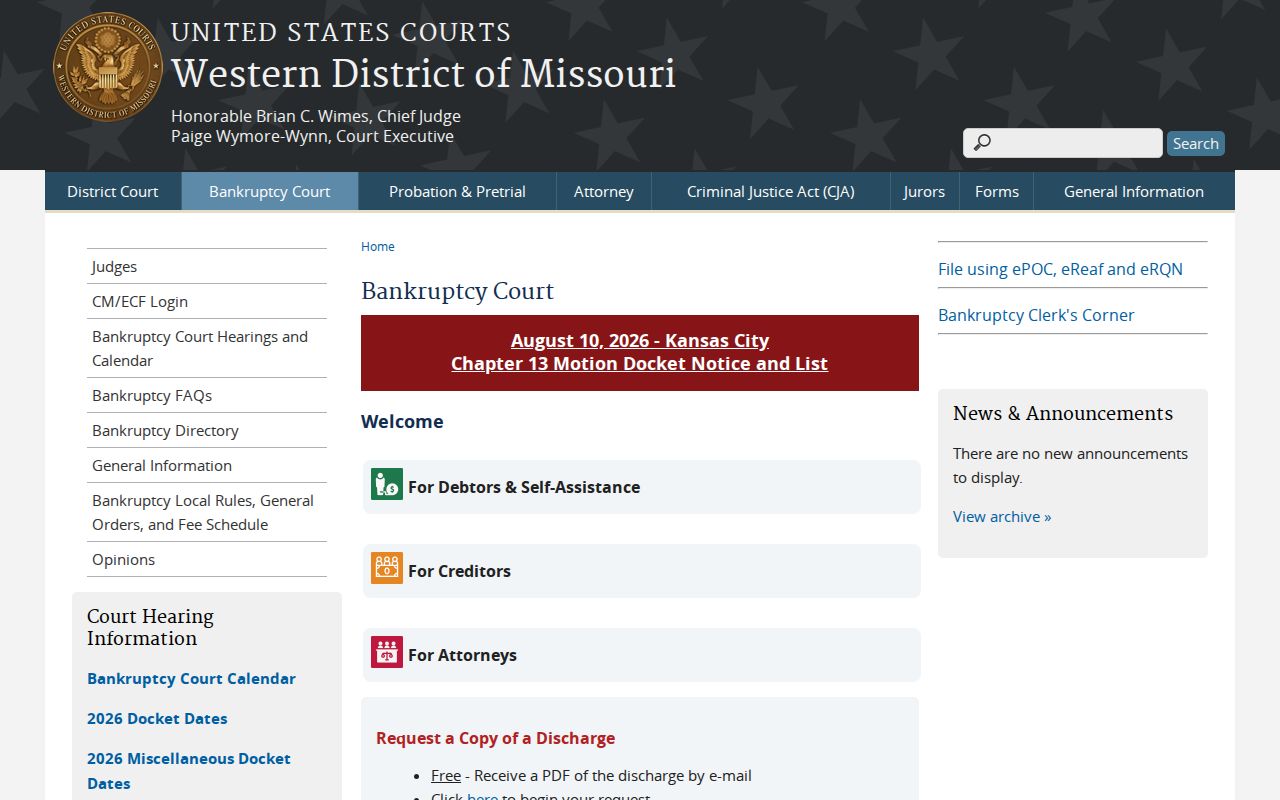
Use the federal source only when a bankruptcy issue is present. Continue with the local Probate Division for wills, letters, estate orders, guardianships, and conservatorships.
Locate Missouri Probate Divisions
Every Missouri jurisdiction has a Circuit Court probate route, but the counter name, judge assignment, local rules, fees, and archives differ. Browse the directory of all 115 Missouri jurisdictions to reach the right court records site. Then confirm whether the requested file is available in Case.net, at a public terminal, through the Probate Clerk, by mail or email, or in an archive. Use the county where venue belongs, not merely the place where property or a relative happens to be found.