
Missouri Arrest Records Explained
Missouri arrest records are administrative law-enforcement records of taking a person into custody. A booking sheet may identify the person, booking time, arresting agency, alleged offenses, holds, bond, and release status. It does not prove that a prosecutor filed the same allegations or that a court found guilt. Police send reports to the county prosecuting attorney, the St. Louis circuit attorney, or a municipal prosecutor. That official may refuse charges, seek more investigation, file different counts, or present a matter to a grand jury.
The court charge record begins once a charging instrument is filed and the Circuit Clerk opens or updates the case. Court charges after arrest use Missouri statutes or municipal ordinances and have their own count numbers, classes, pleas, amendments, and dispositions. Jail booking detail belongs with the sheriff or local corrections agency, while the filed charge and final outcome belong in the court file. Current custody and roster detail are addressed through Missouri inmate records; the court docket answers what happened after filing.
Find Missouri Arrest Records
No single source answers every Missouri arrest and charge question. Search the arrest county's official sheriff roster or records unit for booking facts. Request the open arrest or incident portions from the arresting police agency. Use Missouri Case.net for public filed charges, docket events, pleas, and dispositions. Contact the prosecutor for releasable charging-decision records. Use the Missouri county directory to locate the filing Circuit Clerk when a case document is not remotely viewable or certified proof is required.
- Identify the arresting agency, arrest date, and likely filing jurisdiction. A city ordinance matter may remain in a municipal division.
- Search Case.net by exact defendant name or case number, then compare the filing court, date, and identity details.
- Open the charge list and read each count's statute, class, offense date, amendment history, plea, and disposition.
- Request the booking sheet from the sheriff and the complaint, information, indictment, docket, or judgment from the Circuit Clerk.
The Missouri State Highway Patrol maintains the central criminal-history repository. Its MACHS name search provides open Missouri history submitted by reporting agencies, while an authorized fingerprint check confirms identity and can include FBI material for an eligible purpose. A repository result may connect arrests, prosecutor or court charges, and reported dispositions across jurisdictions. Reporting gaps and delays still occur. Resolve a missing outcome with a certified court disposition and ask the originating agency to transmit a correction.
Missouri Charging Documents
An arrest does not dictate the filed counts. A complaint can begin the case and support judicial review of probable cause. In a felony matter, an associate circuit judge may conduct a preliminary hearing unless it is waived. The prosecuting attorney can then file an information, or a grand jury can return an indictment. Grand-jury proceedings are secret even if a filed indictment later becomes public. Municipal informations and uniform citations commonly start ordinance, traffic, infraction, or misdemeanor matters in associate or municipal divisions.
| Complaint | Information | Indictment | |
|---|---|---|---|
| Source | Written accusation supported as law and rules require | Formal charge filed by the prosecuting attorney | Formal accusation returned by a grand jury |
| Role | Can begin proceedings and support probable-cause review | Common felony charging instrument after screening or waiver | Charges through the grand-jury process |
| Caution | Not proof beyond a reasonable doubt | May be amended subject to law and due process | Proceedings stay secret and the filing may be sealed |
Missouri Charge Status Terms
Read the status of each count and the overall case separately. One charge may be dismissed while another ends in conviction. “Pending” means unresolved. “Filed” says only that a prosecutor initiated the count. “Amended” means the legal count changed, so the current text should not be confused with the booking allegation. “Dismissed” or “nolle prosequi” is not a conviction. “Not guilty” records an acquittal. “Guilty plea” or “found guilty” leads to judgment and sentence.
- No bill
- A grand jury did not indict the proposed charge.
- Refused
- A prosecutor or agency status that may never produce a public court case.
- SIS and SES
- Different Missouri forms of suspended sentence treatment; read the judgment and governing law.
Missouri Charges vs Convictions
A booking allegation and a filed charge are accusations, not findings of guilt. The prosecutor may file fewer, more, or different counts than the jail shows. A conviction arises only after a guilty plea or finding and judgment. Missouri arrest records and public court charges can remain visible when a count is dismissed, amended, or ends in acquittal, unless later law or an order restricts access. Describe the result with the exact case disposition rather than labeling a person from an initial arrest code.
| Charge | Conviction | |
|---|---|---|
| Stage | Accusation | Verdict or plea |
| Burden of Proof | Probable cause | Beyond reasonable doubt |
| Proof to use | Filed charging document | Certified judgment and disposition |
Missouri Sealed and Expunged Arrests
Missouri uses “expungement” for a statutory process that closes qualifying arrest, plea, trial, or conviction records from general public access. Section 610.140 requires a petition in an eligible municipal, associate circuit, or circuit court and contains exclusions, timing rules, limits, notice, and public-welfare findings. Arrest-only relief has its own conditions. A granted order reaches named record holders, which close covered records under section 610.120 and seek corresponding central-repository action. Closed does not always mean physically destroyed.
| Sealed | Expunged | |
|---|---|---|
| Basis | Statute, operating rule, or court order | Section 610.140 petition and order |
| Public effect | Index or documents are restricted as directed | Covered records close from general public access |
| Agency access | Depends on the sealing authority | Specified justice, licensing, and other users can retain lawful access |
Missouri Charge Codes and Classes
A court charge can show the count number, offense description, Missouri statute or municipal ordinance, offense date, felony or misdemeanor class, attempt or accessory designation, amendment path, plea, and disposition. Missouri uses felony classes A through E, misdemeanor classes A through D, infractions, and unclassified offenses. The letter is not a complete sentence forecast. Enhancements, persistent-offender findings, attempts, and offense-specific law may change exposure.
The Missouri public-record custodian statute explains request response and permitted cost principles.
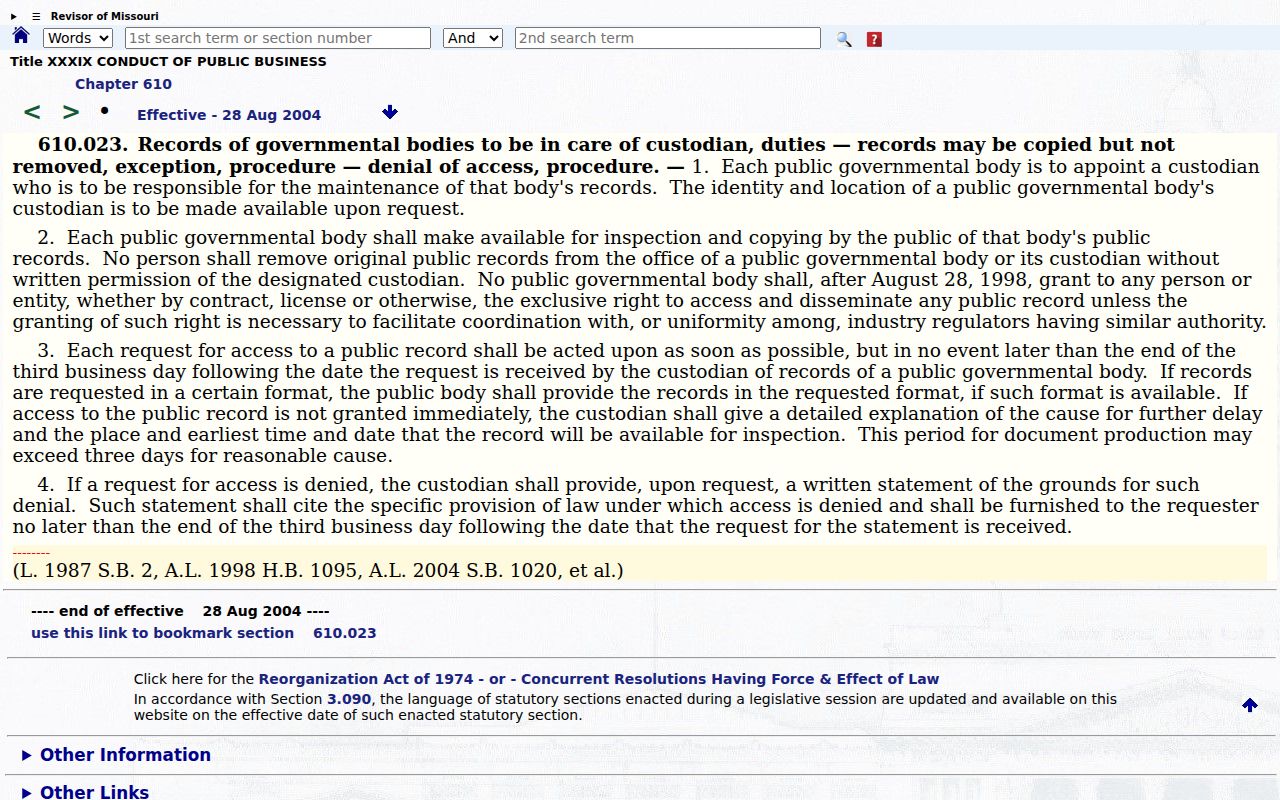
A narrow request should identify the agency, date range, incident or case number, and exact booking sheet, report, charging document, or judgment sought.
Missouri Statewide Charge History
The MACHS Name Search provides Missouri open criminal-history entries from the MSHP central repository. The official fee is $15 per name request, with optional notarization for $5 more, subject to checkout verification. It excludes closed Missouri and FBI records. A fingerprint check is the identity-confirmed route for authorized state and FBI purposes. Neither product supplies the full court pleadings. Retrieve the certified docket or judgment from the filing Circuit Clerk when the exact legal outcome matters.
Missouri law separately addresses open and closed arrest or incident information in section 610.100.
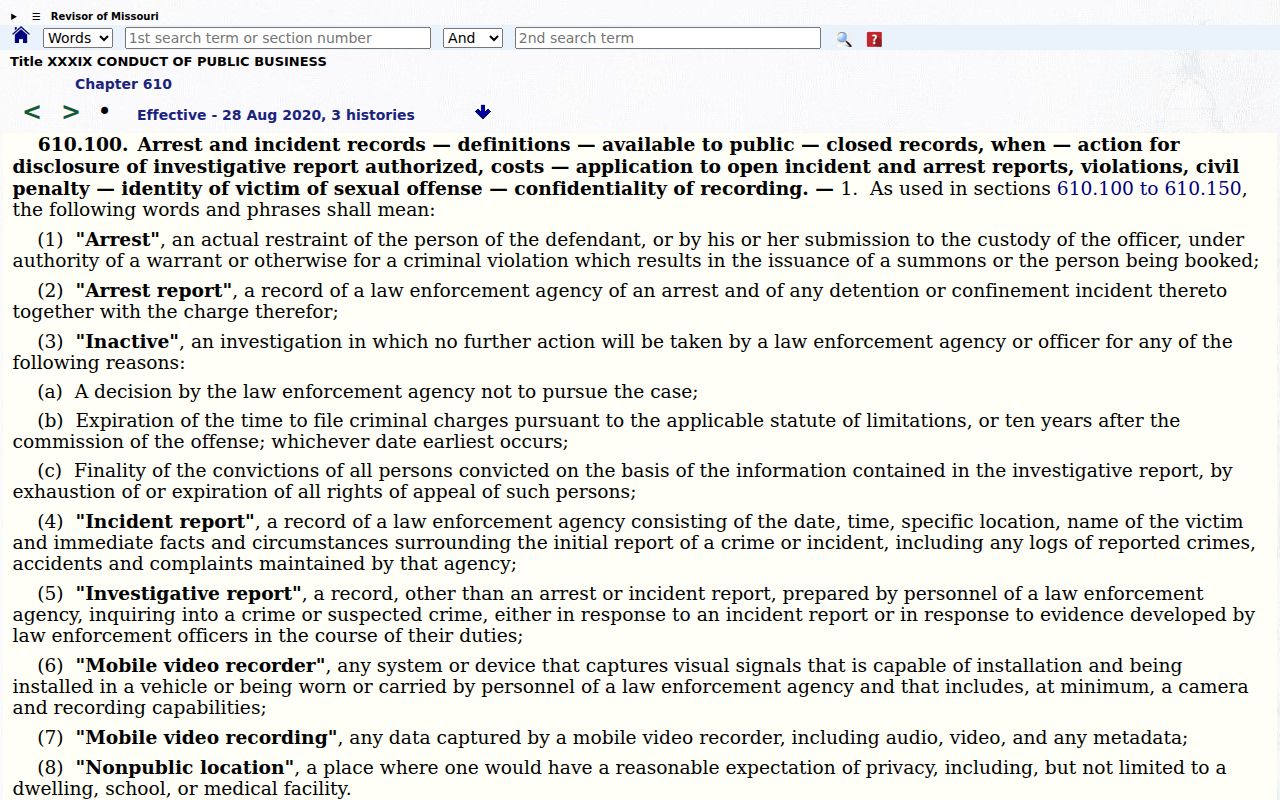
The statute does not make a sheriff booking file, police investigation, court docket, and statewide history the same record.
Correct Missouri Arrest Records
Different systems update at different times. The sheriff can still show an arrest label after the prosecutor files another count. MACHS may lack a disposition because the reporting link was incomplete. Begin with a certified docket or judgment. Ask the agency that created the wrong segment to correct it and transmit the update to MSHP. Match name, date of birth, booking number, case number, county, and offense date before merging records. Fingerprints may be needed to resolve a same-name identity problem.
Important: Employment, housing, credit, and insurance consumer reports require a lawful purpose and the notices and dispute rights required by the FCRA.
Restricted Missouri Arrest Records
Juvenile records, adoption files, mental-health materials, protected addresses, victim and witness details, personal identifiers, sealed filings, and expunged cases do not receive ordinary public access. A public probable-cause filing can contain redactions even when the docket entry remains visible. Investigative work product can also remain closed although basic arrest or incident facts are open. Ask for a segregable redacted copy and the precise authority for any withheld part.
The Missouri closed-record access statute shows that authorized access can survive public closure.
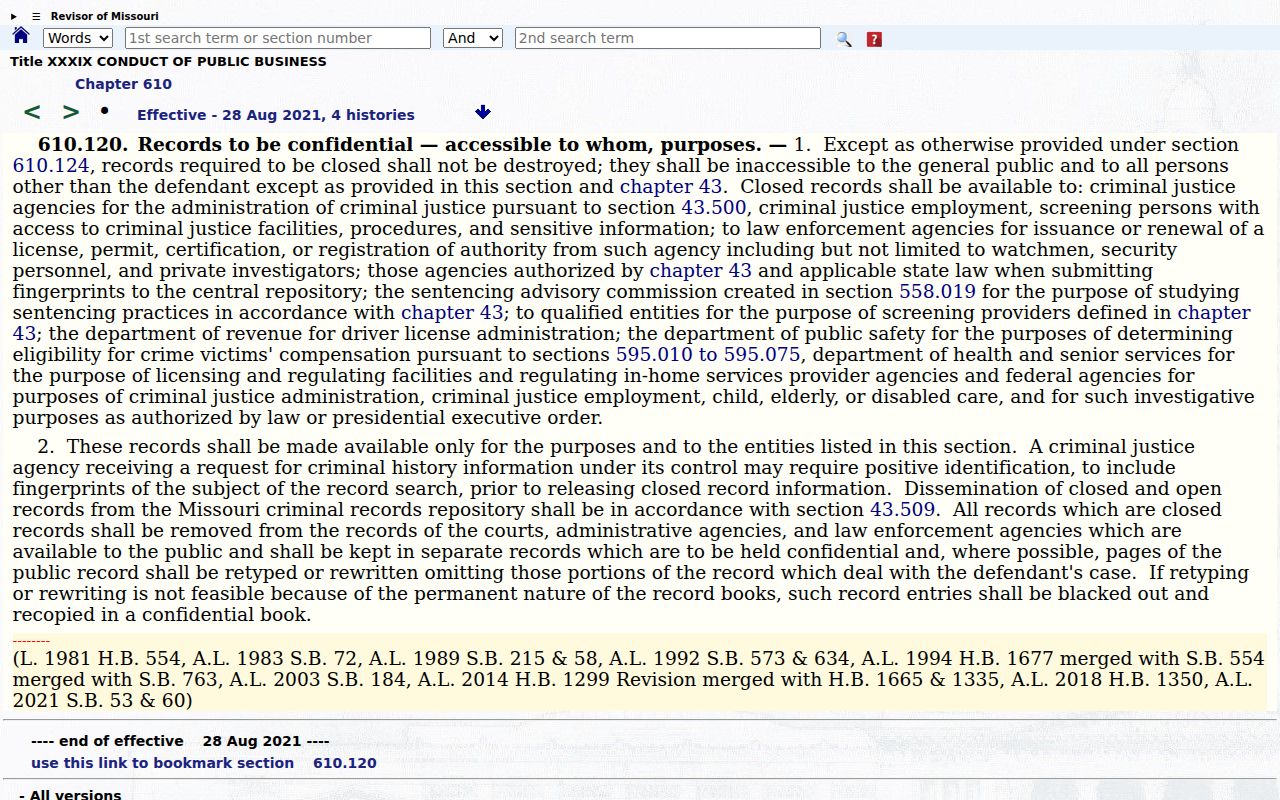
Public disappearance after an order should not be described as universal deletion from all government systems.
The current Missouri expungement statute contains the controlling eligibility and petition text.
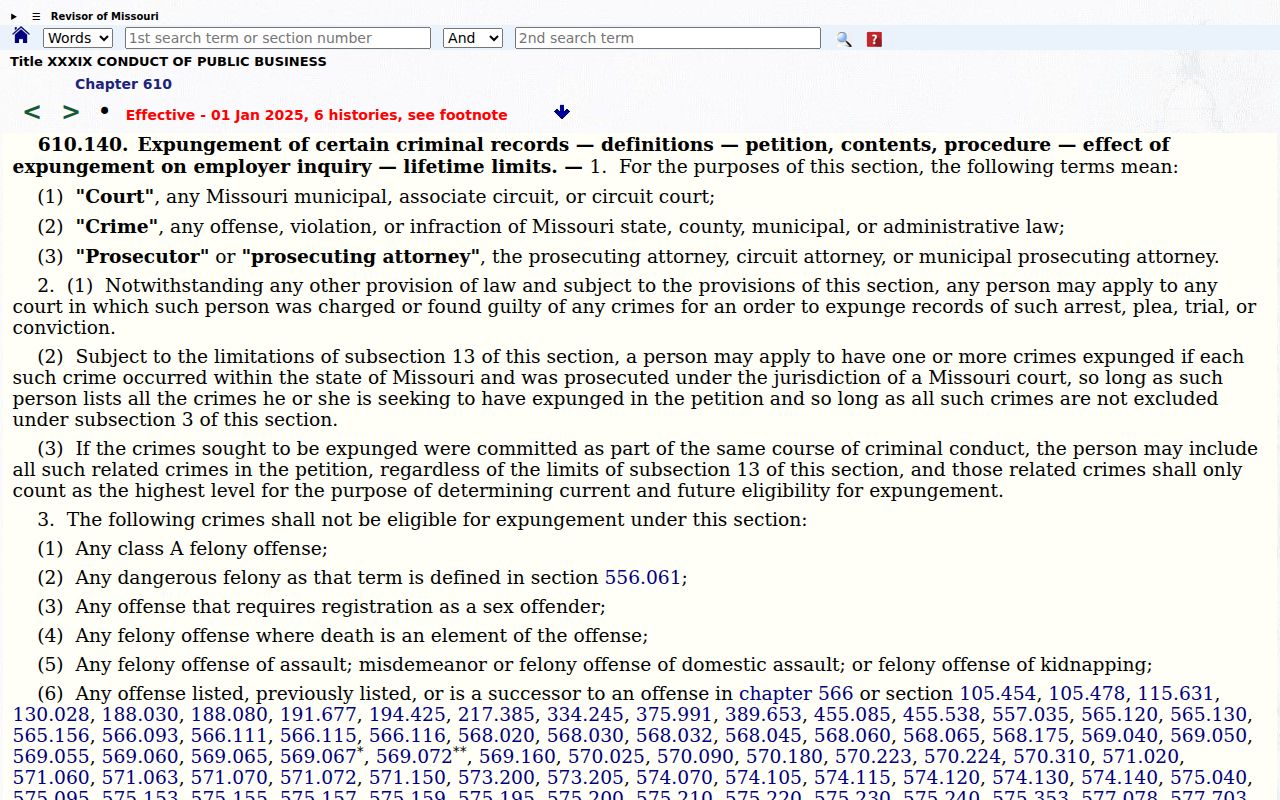
For source documents, choose the arrest and filing jurisdiction in the Missouri county directory, then contact its sheriff, police custodian, prosecutor, Circuit Clerk, or municipal clerk as the record requires.