
Search Missouri Court Records Online
Case.net is the Missouri Judiciary's public index for records entered in the State Courts Automated Case Management System. It reaches Circuit Court, participating municipal divisions, and appellate matters through several search routes. The index is broad, yet it does not guarantee coverage of every old paper case, local municipal file, confidential action, or document image. The Circuit Clerk remains the custodian of the trial-court file. Appellate clerks hold appellate originals, while a municipal clerk may be the best contact for a city-ordinance case.
Prepare the party's legal name, the county or court location, an approximate filing year, and the case type. A complete case number is the strongest key because common-name results can span many Missouri jurisdictions. Copy the number exactly from a ticket, notice, or pleading. If the filing place is unknown, search statewide first, then confirm the style, court, filing date, and parties before treating a result as the intended Missouri court record.
- Open Case.net and choose Litigant Name, Filing Date, Case Number, or Scheduled Hearings and Trials.
- Enter the least ambiguous details available. Add a location, first name, middle name, date range, or case type when the search route permits.
- Open the case-number link and confirm the case header, parties, court location, filing date, type, and current status.
- Review Docket Entries, Charges or Judgments, Parties and Attorneys, scheduled events, and any linked File Viewer images available to the public.
- If a public image is missing, use a courthouse terminal or ask the Circuit Clerk for inspection, a plain copy, or a certified copy.
The Case.net File Viewer help explains that a linked docket description can open an image when the document and user access level allow it. An E-CASE label means the official file is electronic, not that every image is open to an anonymous remote user. Track This Case can send activity notices for eligible matters, but it does not replace service of an official court notice.
Missouri Court Records Search Fields
Case.net offers distinct search routes, so the visible controls change with the route selected. Required status is not marked consistently across every live form. Name searches work only when a person or business is indexed as a litigant; a witness, victim, child, or protected party may not appear. Search labels can also change as the judiciary updates the service.
| Field Label | Type | Required | Notes / Format |
|---|---|---|---|
| Search type | Navigation link or tab | Yes | Litigant Name, Filing Date, Case Number, or Scheduled Hearings and Trials |
| Last Name / Business Name | Text | Route-dependent | Use the legal name shown on filed papers |
| First and Middle Name | Text | No | These fields narrow common-name results |
| Case Type | Dropdown | No | Available groups vary by search route |
| Court / Location | Dropdown | Route-dependent | Includes counties, St. Louis City, appellate courts, and participating locations |
| Filing or Hearing Dates | Date range | Route-dependent | Use the live form's required date format |
| Case Number | Text | Case-number route | Preserve letters, numbers, and dashes from the source document |
| Judge / Commissioner | Dropdown or text | No | Offered only on some location or hearing searches |
Types of Missouri Court Records
Missouri's Circuit Court is one constitutional trial court with circuit-judge, associate, probate, family, juvenile, treatment, small-claims, and municipal divisions. The division affects assignment and confidentiality, but it does not create a separate statewide court tier. The filing location controls which Circuit Clerk or municipal clerk can certify the original record.
Civil files can include petitions, service returns, answers, motions, orders, judgments, executions, garnishments, and satisfactions. Criminal files can contain a complaint, information or indictment, bond orders, pleas, motions, verdicts, sentences, and appeals. Family records include dissolution, paternity, custody, support, and protection-order matters, though financial sheets, child records, and protected addresses may be secured. Probate files concern estates, wills, guardianships, and conservatorships. City ordinance and many local traffic cases arise in municipal divisions.
- Civil: general civil, associate civil, landlord-tenant, small claims, judgment enforcement, and related appeals.
- Criminal: felony, misdemeanor, preliminary, bond, plea, disposition, sentence, and probation events.
- Family: dissolution, legal separation, custody, support, paternity, modification, and enforcement.
- Probate: decedent estates, wills, letters, claims, settlements, guardianships, and conservatorships.
- Municipal and traffic: city-ordinance violations, local tickets, hearings, judgments, and associated warrants.
- Appellate: notices, legal files, briefs, argument schedules, opinions, orders, and mandates.
Juvenile and adoption matters require special care. A public search will not expose confidential juvenile social records or adoption material merely because the underlying Circuit Court exists in the statewide system. Older exhibits may also have been returned or disposed of under retention rules, so the clerk should confirm what remains.
What Missouri Court Records Show
A public Missouri case page combines identity, chronology, charge or judgment, hearing, document, and financial data. The exact tabs depend on case type and security. A docket line proves an event was entered, but not that the underlying image is remotely viewable. Financial balances may lag and should not be treated as a certified payoff. Common case codes include CR for criminal, CV for civil, SC for small claims, DR for dissolution, PR for probate, JU for juvenile, and TR for traffic, though legacy and municipal formats can differ.
| Field | What It Shows |
|---|---|
| Case header | Case number, style, court, county, circuit, division, type, filing date, judge, status, and disposition date |
| Parties and counsel | Party names and roles, attorneys, represented side, and limited address details when public |
| Docket chronology | Filings, service, settings, motions, hearings, continuances, orders, trial, judgment, sentence, and appeal events |
| Criminal charges | Count, statute or ordinance, class, offense date, amendment, plea, finding, disposition, and sentence |
| Civil judgments | Creditor, debtor, amount, date, costs, status, and satisfaction when entered for public display |
| Hearings | Date, time, event type, division, judge, and result or continuance when recorded |
| Documents | Public images linked through File Viewer, with access controlled by case and document security |
| Financial data | Costs, fines, restitution, bonds, judgments, payments, and balances that may require clerk verification |
The most important field is often disposition. A filed charge is only an accusation. The result may be a dismissal, acquittal, guilty plea, guilty finding, suspended imposition of sentence, or suspended execution of sentence. A disposition should be read alongside the charge history because counts can be amended or disposed of separately.
CourtListener and its RECAP collection offer a free research alternative for opinions and contributed federal docket documents.
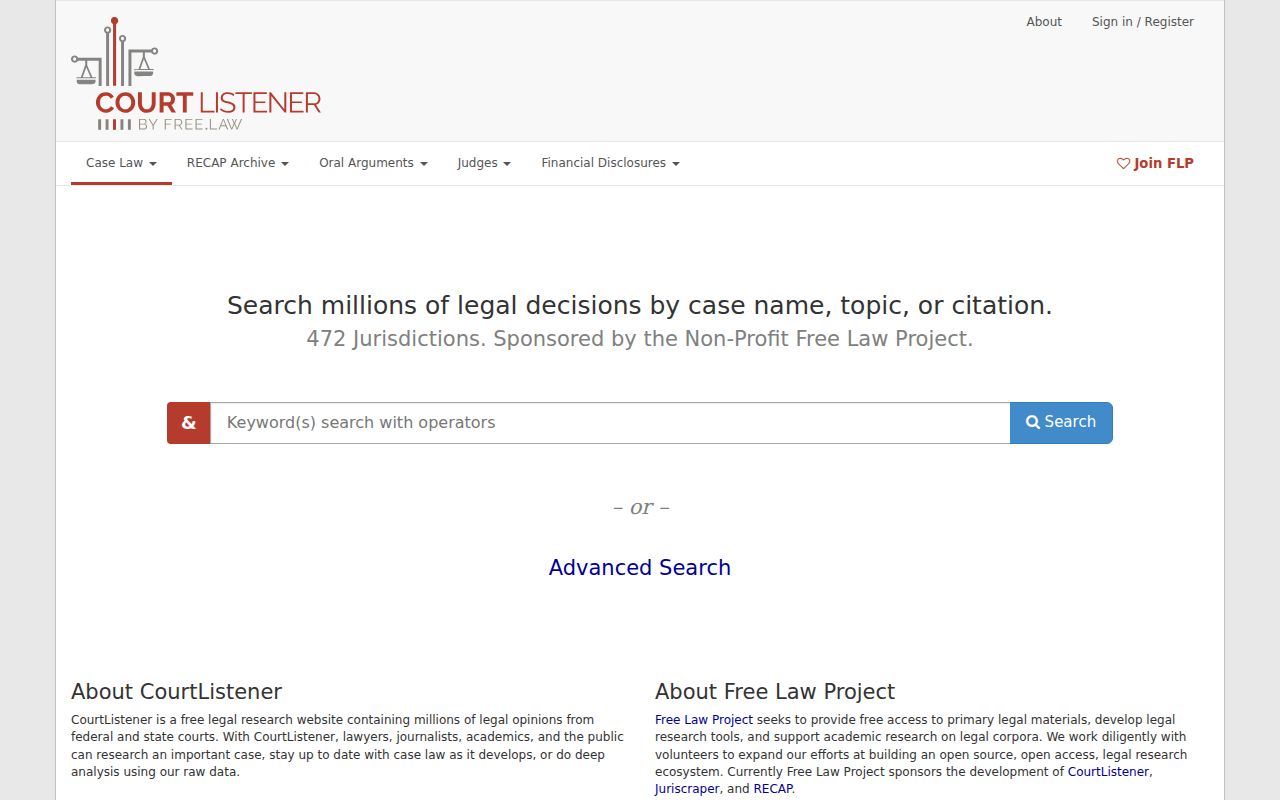
CourtListener can help locate opinions, but it is not Missouri's official court-record repository and may be incomplete. Certified state records still come from the appropriate Missouri clerk.
Missouri Court Records Access Rules
Judicial case-file access is governed chiefly by Missouri court rules, security settings, sealing orders, and the Court Operating Rule 2 access framework. Chapter 610 remains important for executive and local agency records and for administrative material held by a public body. Under section 610.023, RSMo, a custodian must act on open-record requests as soon as possible and explain the cause and earliest available time when access cannot be immediate. That rule does not create a universal deadline for production of every Missouri court image.
Ask for the precise document, case number, date range, copy format, and certification level. Inspection may avoid copy costs. Local clerk charges vary: official circuit examples range from 25 cents to $1 per page, and one example adds $1.50 for a certified seal. These are examples, not a statewide price promise. Certification, authentication, mail, media, card convenience, archive research, redaction, service, publication, and transcripts can add separate charges. Obtain a written quote before sending payment.
Note: A public docket entry does not guarantee anonymous access to its document image; courthouse terminals can expose a broader lawful view.
Restricted Missouri Court Records
Missouri public access does not fully expose juvenile court and social records, adoption files, mental-health evaluations, confidential attachments, protected addresses, certain victim or child roles, or sealed and expunged cases. Social Security numbers, complete birth dates, financial-account numbers, and confidential addresses should not appear in public images. The confidential Filing Information Sheet captures sensitive party data for court administration but is not an ordinary public filing.
Section 211.321, RSMo controls juvenile confidentiality. For eligible criminal matters, section 610.140, RSMo provides the petition process, exclusions, timing rules, and required findings for expungement. A granted order closes records under section 610.120, but it does not promise physical destruction or erase access for every authorized justice or licensing body. The petition belongs in a qualifying Missouri municipal, associate circuit, or circuit court connected with the charge or finding.
When a public page includes sensitive material, request a segregable redacted copy instead of assuming the entire document is either open or closed. If a clerk denies access, ask for the statute, operating rule, or order supporting the restriction and whether inspection at a terminal or access by a party or attorney is available.
Find Missouri Court Records Offices
Missouri has a unified Circuit Clerk structure across 114 counties and the independent City of St. Louis, creating 115 local court jurisdictions. The clerk accepts filings, enters docket events and judgments, certifies copies, provides public terminals, and retrieves eligible archived material. Municipal divisions may use their own clerks for city-ordinance cases. Marriage licenses are a separate exception handled by the county Recorder of Deeds.
Use the Missouri county directory to select the filing jurisdiction, then contact the Circuit Clerk or municipal clerk shown there. Provide the case number, style, approximate year, document title, and desired copy type. For mail, ask about accepted payment, a cost quote, and any return-envelope requirement before sending funds. Older files may be held in bound docket books, microfilm, off-site storage, a legacy system, or an archive. The statewide Circuit Clerk overview explains each request channel.
Tip: Search by filing jurisdiction, not current residence; a move does not transfer custody of the original Missouri court record.