
Missouri Court System Overview
Missouri has one high court, one intermediate appellate court divided geographically, and one constitutional trial court organized into local circuits and divisions. The Supreme Court of Missouri is the court of last resort. The Missouri Court of Appeals handles most first appeals through Eastern, Western, and Southern Districts. Circuit Court sits in every county and in the independent City of St. Louis, with those local courts grouped into 46 judicial circuits.
Associate circuit judges and probate, family, juvenile, treatment, small-claims, and municipal divisions do not form extra statewide tiers. They operate within Circuit Court. Felonies and broad civil matters are heard by circuit judges; statutes and local orders assign many misdemeanors, traffic matters, landlord-tenant actions, small claims, and preliminary criminal proceedings to associate divisions. Municipal divisions hear city-ordinance violations.
Ordinary appeals path: Circuit Court › Missouri Court of Appeals › Supreme Court of Missouri
| Court Level | Court Name | Jurisdiction / Case Types | Number in Missouri |
|---|---|---|---|
| Court of last resort | Supreme Court of Missouri | Final state review, exclusive constitutional appellate categories, supervision, and rulemaking | 1 court, 7 judges |
| Intermediate appellate | Missouri Court of Appeals | Most appeals from Circuit Court and extraordinary writs | 1 court, 3 districts |
| General trial | Circuit Court | Felony, civil, family, probate, juvenile, real-estate, injunction, and writ matters | 46 judicial circuits, 115 local jurisdictions |
| Assigned trial divisions | Associate Circuit and Small Claims Divisions | Statutorily or locally assigned misdemeanor, traffic, landlord-tenant, small-claims, and preliminary matters | Divisions within Circuit Court |
| Specialized trial divisions | Probate, Family, Juvenile, and Treatment Divisions | Estates, guardianship, domestic relations, juvenile cases, and problem-solving dockets | Divisions or dockets within Circuit Court |
| Municipal division | Municipal Division of Circuit Court | City-ordinance violations, including many local traffic cases | Local divisions, not a separate tier |
Supreme Court of Missouri
The Supreme Court of Missouri has seven judges and sits in Jefferson City. It is the single high court for civil and criminal matters. Missouri has no separate court of criminal appeals. Article V assigns direct appellate jurisdiction over categories including the validity of a United States or Missouri statute or constitutional provision, state revenue laws, title to state office, and cases in which the death penalty is imposed.
Other matters can reach the Supreme Court by transfer after Court of Appeals review or when statewide importance, conflict, or the governing transfer rules support review. The court also supervises Missouri judicial administration and adopts court, attorney-discipline, operating, and automated-system rules. Its public resources include decisions, briefs, argument schedules, dockets, and some recordings. Current leadership should be checked on the official court site because the chief-justice role rotates.
Missouri Court of Appeals
The Missouri Court of Appeals is one intermediate court organized into three geographic districts. Panels review the Circuit Court record for legal error. They do not retry witnesses or receive a new trial record. The filing county determines the district, not the case subject. This court is the practical last stop for many cases because Supreme Court transfer is limited.
| District | Seat | Counties Served |
|---|---|---|
| Eastern District | St. Louis | Eastern geographic district under the official appellate map |
| Western District | Kansas City | Western geographic district under the official appellate map |
| Southern District | Springfield | Southern geographic district under the official appellate map |
Missouri Circuit Courts
Circuit Court is Missouri's court of general original jurisdiction. It hears felony prosecutions, broad civil actions, domestic relations, probate, juvenile, real-estate, injunction, and extraordinary-writ matters. Missouri places a Circuit Court access point in every county and in St. Louis City. The state groups these locations into 46 circuits. A populous jurisdiction may form one circuit, while rural counties may share circuit administration and a presiding judge.
The case remains indexed by filing county and circuit number even when a judge travels or receives an assignment. The Circuit Clerk accepts the initiating paper, creates the case in the statewide system, and maintains the resulting docket and official file. Use the county directory to locate that clerk for public-terminal access, older materials, or certified trial-court records.
Missouri Court Jurisdiction Compared
Missouri jurisdiction should not be reduced to one dollar threshold. Statutes, local administrative assignments, case type, and requested relief affect which Circuit Court division hears a matter. Associate does not mean a separate courthouse or statewide tier. The clerk can identify the assigned division from the case type and filing location.
| Circuit-Judge Division | Associate Circuit Division | Municipal Division | |
|---|---|---|---|
| Core civil work | General civil, injunction, title, family, and matters not assigned elsewhere | Lower-value civil, landlord-tenant, and small claims as assigned | City-code enforcement within municipal authority |
| Criminal work | Felony trials and general criminal jurisdiction | Misdemeanors and preliminary criminal proceedings commonly assigned | Municipal ordinance offenses, including many local traffic charges |
| Special divisions | Family, probate, juvenile, and treatment assignments can operate here | Small claims, traffic, and treatment assignments can operate here | Municipal judge or transferred ordinance docket |
| Record custodian | Circuit Clerk | Circuit Clerk | Municipal clerk or Circuit Clerk under local structure |
| Review route | Geographic Court of Appeals district | Trial de novo or appellate route where law provides | Trial de novo or review path set by law and rule |
Cases Through Missouri Courts
A civil case begins when the clerk accepts the initiating pleading and addresses the filing deposit or waiver. A criminal case begins through the charging process, followed by initial proceedings and assignment. Service, motions, discovery, settings, hearings, trial, judgment or sentence, and post-judgment requests create docket events. A party must preserve claimed error and file a notice of appeal. The clerk assembles the legal file, while a transcript is prepared separately when required.
Criminal case flow: Charge › Initial Appearance › Information or Indictment › Arraignment › Pretrial › Plea or Trial › Sentence › Court of Appeals › Possible Supreme Court Transfer
Civil case flow: Petition › Service › Answer › Discovery › Hearing or Trial › Judgment › Court of Appeals › Possible Supreme Court Transfer
Direct Supreme Court review applies when the Missouri Constitution assigns exclusive jurisdiction. Otherwise, appellate panels review the trial record and legal claims. They generally defer to supported trial-level fact findings while applying the proper legal standard. Reassignment, recusal, or venue transfer may add cross-references, but it does not automatically change the custodian of the original case file.
Missouri Circuit Court Divisions
Probate divisions handle wills, estates, guardianships, and conservatorships. Family assignments address dissolution, paternity, custody, and support. Juvenile divisions hear abuse, neglect, delinquency, and related matters subject to special confidentiality. Small Claims supplies a simplified forum under its own statutory rules. These names describe workload within Circuit Court, not freestanding courts above or below it.
Missouri also authorizes adult drug, DWI, veterans, family, juvenile, mental-health, and other treatment courts under statewide standards and local authority. Judicial monitoring, testing, treatment, supervision, incentives, and sanctions are integrated into an underlying criminal or family case. The public docket may show a treatment-court event while clinical and treatment information remains protected.
Missouri Municipal Court Divisions
Missouri does not use a separate justice-of-the-peace or magistrate-court tier in the way some states do. Associate circuit judges conduct many functions that might carry those labels elsewhere. Municipal divisions of Circuit Court decide city-ordinance cases. A city may keep a municipal judge or transfer ordinance work to an associate circuit judge. Many city traffic matters and related bench-warrant events begin here, making the issuing municipality a crucial search field.
Municipal coverage in Case.net may not answer every local record question. When a docket does not appear, contact the specific municipal clerk as well as the Circuit Clerk. A county-only search can miss a city case even though municipal adjudication remains within the unified Missouri court structure.
Federal Courts Serving Missouri
Federal courts are separate from the Missouri court system and do not use Case.net. The U.S. District Court for the Eastern District of Missouri covers the state's eastern region under federal venue law. The U.S. District Court for the Western District of Missouri covers the remainder. They hear federal crimes, federal statutory and constitutional claims, qualifying diversity cases, and litigation involving the United States. State judicial-circuit lines do not decide federal venue.
The official Eastern District of Missouri source illustrates this separate federal court route.
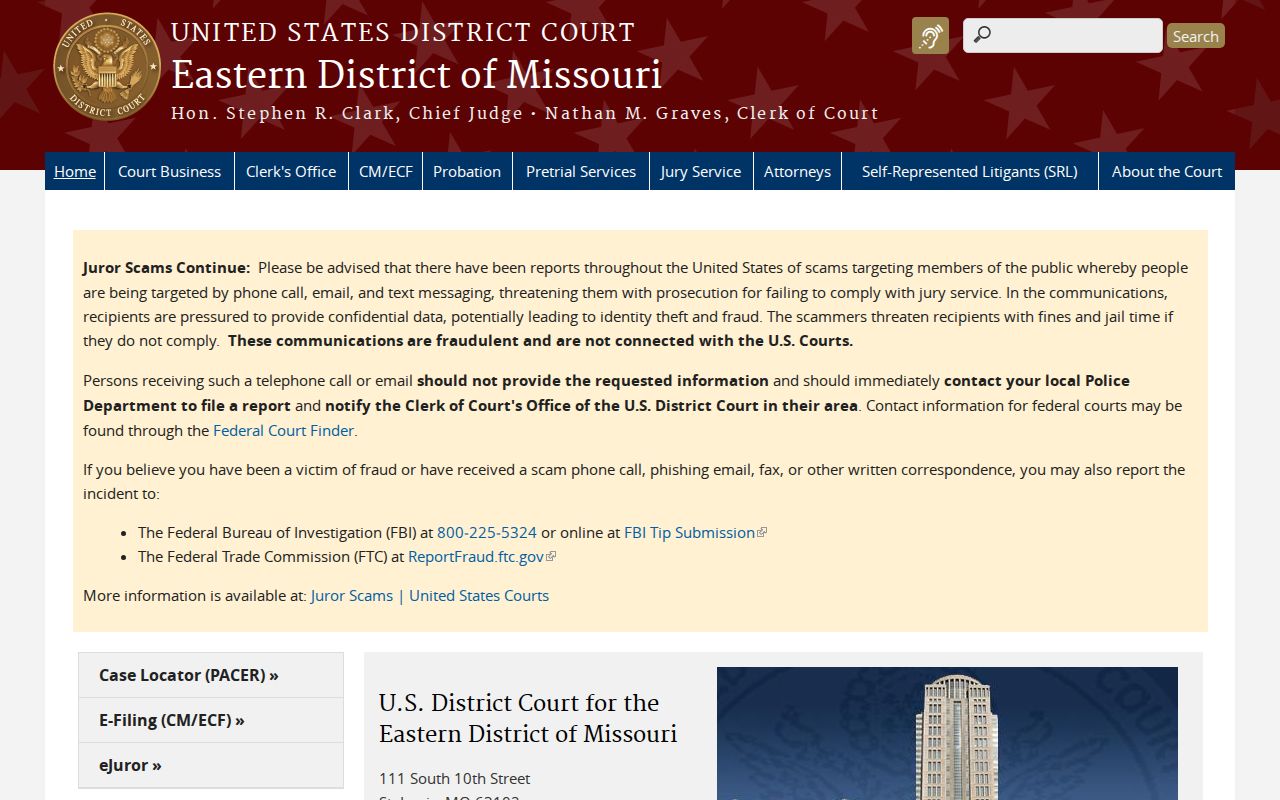
Federal trial records come from the federal clerk and PACER, not a Missouri Circuit Clerk. Bankruptcy is also federal, with separate bankruptcy courts for the Eastern and Western Districts.
The official Western District of Missouri source shows the second federal trial-district branch serving Missouri.
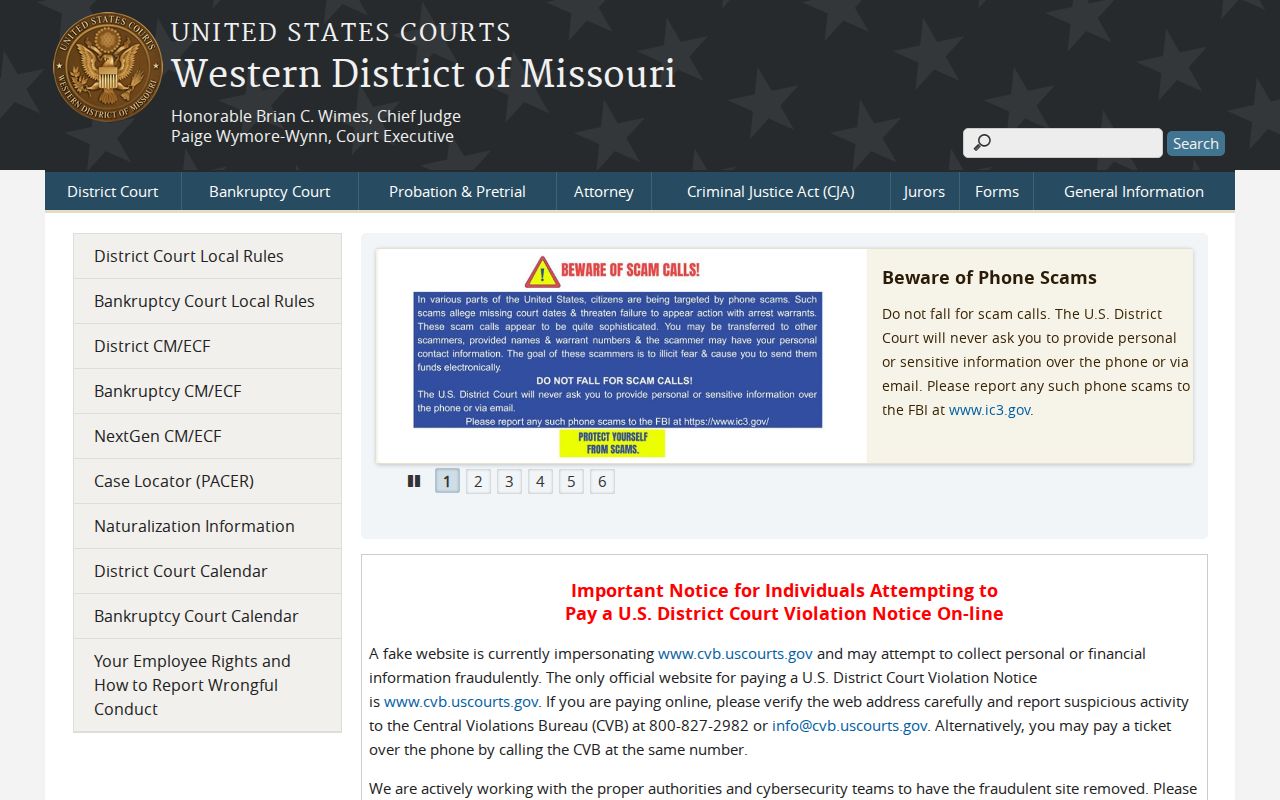
Appeals from both districts and both bankruptcy systems ultimately enter the federal appellate structure. Registration and the current federal fee rules apply to PACER access.
Federal appeals from Missouri go to the U.S. Court of Appeals for the Eighth Circuit.
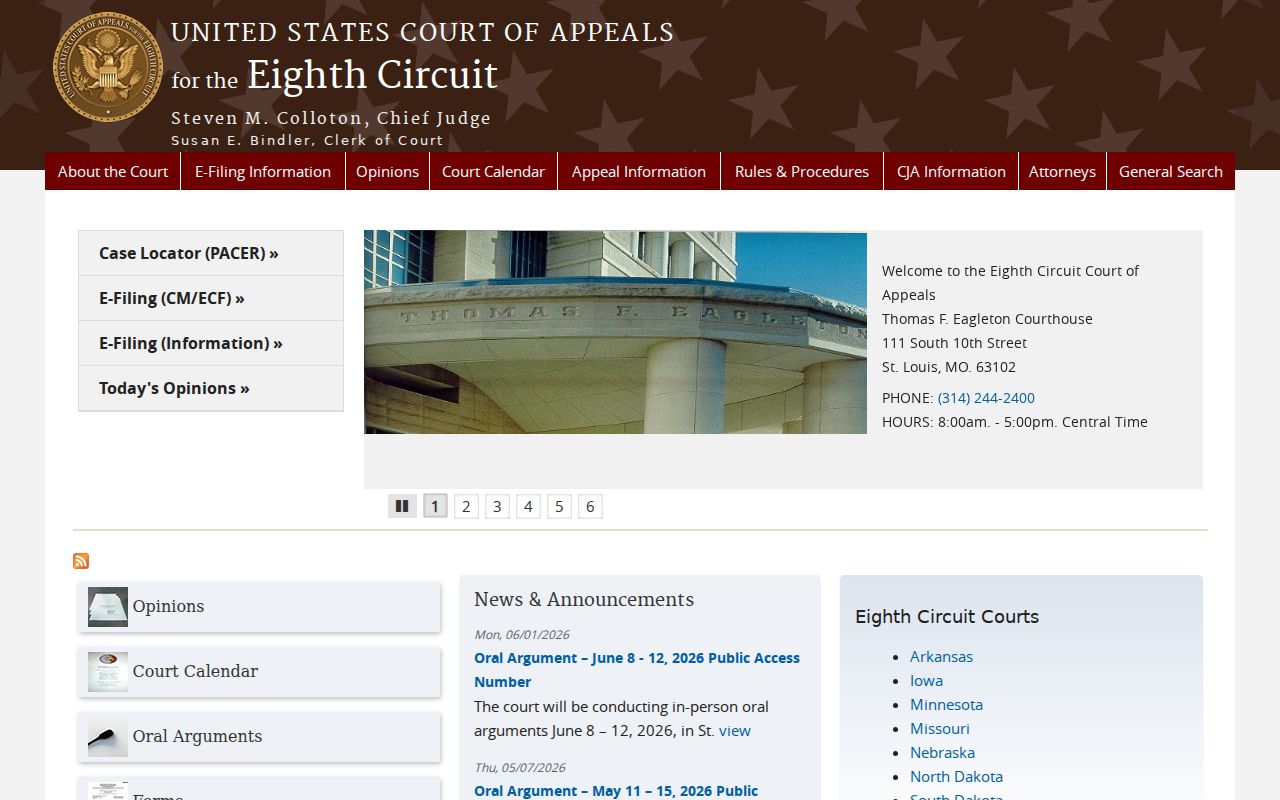
The Eighth Circuit reviews federal, not Missouri state, trial judgments. Only a federal question can support further review of a state judgment by the U.S. Supreme Court.
History of Missouri Courts
Article V of the Missouri Constitution supplies the judiciary's foundation. The 1945 Constitution reorganized judicial power, and voters later approved the 1976 Judicial Article. The modern unified structure took effect in 1979, consolidating fragmented local courts into Circuit Court and creating the associate circuit judge role. That transition explains why older records may use magistrate or other court titles that no longer describe the current custodian.
The Missouri Plan, first adopted in 1940, became an influential nonpartisan selection model. It applies to appellate judges and specified urban circuit judges: a commission nominates candidates, the governor appoints one, and voters later decide retention. Other circuit and associate judges are chosen through partisan elections unless a jurisdiction adopts the plan. Missouri therefore uses a state-specific mix rather than one selection system for all judges.
Case.net, statewide eFiling, and electronic official files later shifted public research from local paper indexes toward a statewide case index. An E-CASE label identifies the electronic official file, while access rules still distinguish anonymous users, courthouse terminals, attorneys, and court personnel. Those modern tools did not erase older books, microfilm, or archive holdings.
Find Missouri Circuit Courts
Missouri trial records belong to the filing jurisdiction. The Circuit Clerk maintains case files, dockets, judgments, and certified copies, while a municipal clerk may keep the working record for a city-ordinance division. Browse the full directory of 115 Missouri court jurisdictions to reach the correct local court source. Search Case.net first, then use the clerk for missing images, public-terminal access, archived material, or formal certification.
Note: Filing county, not current residence, controls the local clerk that holds an original Missouri Circuit Court record.