
What Missouri Court Dockets Mean
A docket is the court's chronological register of action in one case. It can show when a petition, complaint, information, motion, answer, or notice was filed; when service issued or returned; when a hearing was set or continued; and when the judge entered an order, judgment, plea, verdict, or sentence. The docket is an index and procedural history. It is not the same as the full file, which contains the actual pleadings, orders, exhibits, and other documents.
Missouri's Circuit Court is the single trial court of general jurisdiction. Circuit-judge and associate circuit divisions share the same constitutional court, while probate, family, juvenile, treatment, small-claims, and municipal work is organized into divisions or specialized dockets. The elected Circuit Clerk maintains civil, criminal, family, probate, and many traffic docket records. A municipal division may use a municipal clerk, so a city-ordinance ticket may require a municipality search even when a county-only query returns nothing.
Appellate dockets have a different focus. The Missouri Court of Appeals records notices, briefs, motions, argument settings, submissions, opinions, and mandates across its Eastern, Western, and Southern Districts. The Supreme Court of Missouri posts dockets and material for matters in its jurisdiction. Trial dockets capture evidence-related steps and judgments; appellate dockets track review of the legal record rather than a new witness trial.
Search Missouri Court Dockets Online
Case.net is the statewide starting point for public Missouri court dockets entered in the automated case-management system. Search routes include Litigant Name, Filing Date, Case Number, and Scheduled Hearings and Trials. Results can cover Circuit Court divisions, participating municipal matters, and appellate records, but confidential cases, older paper files, converted matters, and some local records may be absent or limited.
- Choose the search route that matches the known fact. A complete case number is best; a legal name plus filing location is the next strongest combination.
- Enter the number exactly or narrow a name search by first name, middle name, court location, case type, or date where offered.
- Open the case-number link and verify the style, court, filing date, parties, and type before relying on the result.
- Select Docket Entries and read events in date order. Check scheduled events and Charges, Sentences, or Judgments when those tabs appear.
- Open a linked docket description to view an eligible image. If an image is not remotely exposed, ask the filing clerk about a public terminal or copy request.
A statewide name search can return unrelated people. Protected parties may not be searchable by name at all. Track This Case can provide notices of new activity in eligible cases, but a tracking alert is not formal service and Fine Collection Center matters may not qualify. If a result cannot be found, use the county directory to reach the Circuit Clerk or municipal division that created the docket.
Read Missouri Court Docket Entries
A Case.net docket row usually identifies the entry date and gives a code or plain-language description. It can also name the filing party, show free text entered by the court, and link to a document when the current user may view it. The available detail varies with case type, court level, local practice, and security. A linked image is part of the file; an unlinked row can mean no attachment exists or that remote access is not allowed.
| Field | What It Shows |
|---|---|
| Entry date | The date a filing, court action, service return, setting, or result was entered |
| Code / description | The event label, such as motion filed, hearing scheduled, continuance, order, judgment, plea, or sentence |
| Party filing | The party or attorney associated with a pleading when that information is entered |
| Docket text | Short clerk or judicial details about the event, result, setting, or linked document |
| Document link | A File Viewer link for a public image available to the current user's access level |
| Scheduled event | Hearing or trial date, time, event type, division, and judicial officer when published |
| Disposition event | Dismissal, judgment, plea, finding, sentence, satisfaction, mandate, or another terminal action |
Do not read one line in isolation. A motion filed is a request, not a ruling. A warrant entry may show issuance, recall, quash, or service, so confirm the latest event with the issuing court. A charge line is not a conviction. Read the final disposition and any later amendment, sentencing, probation, appeal, or mandate entries before drawing a conclusion.
Missouri Courts With Public Dockets
Case.net is broader than a typical county portal because Missouri uses a statewide case-management system. Still, the access route depends on the court that made the record. Court security and document rules can expose a public docket while keeping a confidential attachment or protected name out of remote view. Courthouse terminals remain a key channel for public electronic material not released anonymously online.
- Supreme Court of Missouri: appellate dockets, briefs, argument schedules, decisions, and related public material through the judiciary.
- Missouri Court of Appeals: district appellate events, briefing, argument, opinions, orders, and mandates.
- Circuit Court: civil, criminal, family, probate, and other division events indexed through Case.net and the Circuit Clerk.
- Associate Circuit divisions: many misdemeanor, traffic, landlord-tenant, small-claims, and preliminary criminal events.
- Municipal divisions: city-ordinance and local traffic dockets, with coverage that may require the specific municipal clerk.
Missouri federal courts do not use Case.net. Federal trial and bankruptcy dockets are searched through PACER, and their records are held by the federal clerk. State circuit boundaries do not determine federal venue.
The official PACER federal case search provides the federal docket route for Missouri cases outside Case.net.
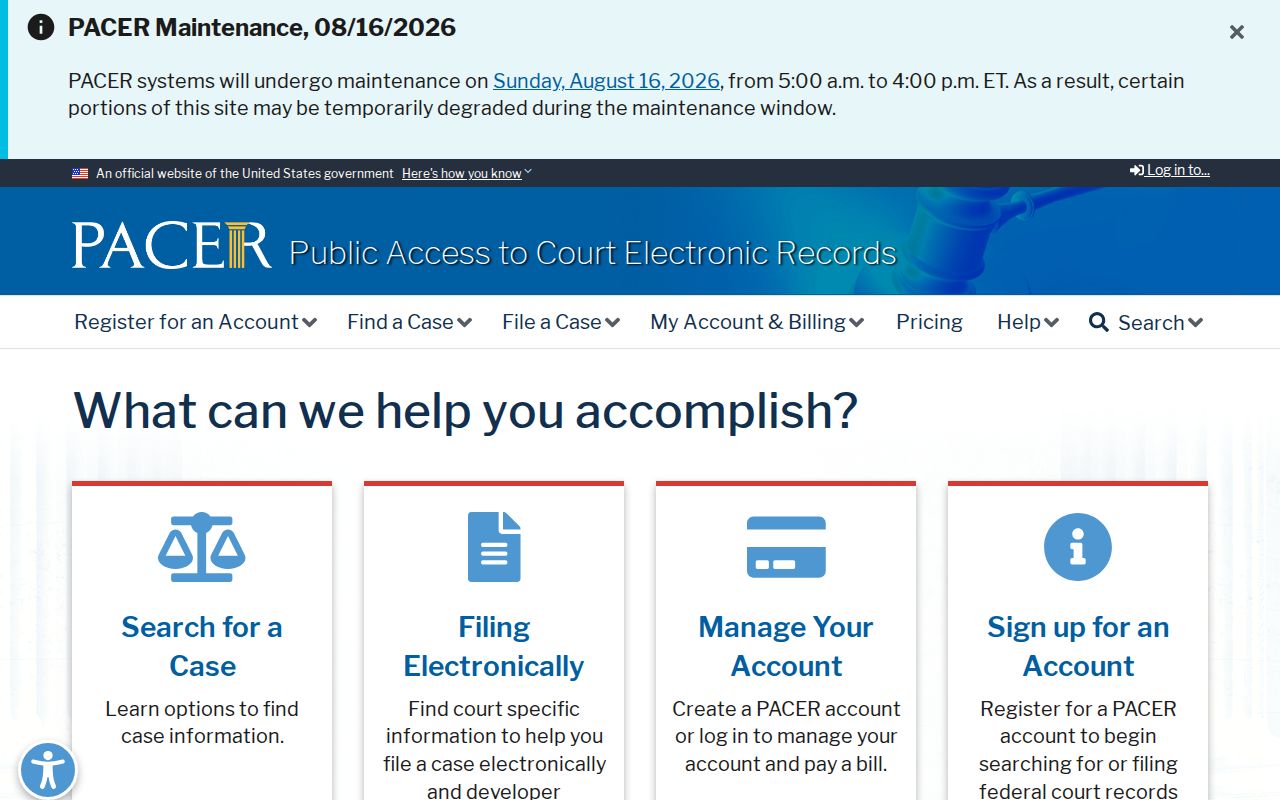
PACER requires registration and applies its federal fee schedule. It should be used only for federal matters, while Missouri state and local court dockets begin with Case.net.
Missouri Dockets Versus Case Files
A Missouri docket tells when something happened and gives a short label. The full case file supplies the actual petition, charging instrument, answer, motion, order, judgment, exhibit index, or other retained document. A transcript is different again: it is the spoken proceeding reduced to a record through the court reporter or approved transcription process. Transcript pricing does not follow the ordinary clerk copy rate.
| Docket | Full Case Record | |
|---|---|---|
| Format | Dated list of events and short text | Pleadings, orders, judgments, notices, and retained exhibits |
| Remote access | Often shown in Case.net when public | Only eligible linked images are open remotely |
| Local access | Clerk can supply an official or certified docket | Inspection, public terminal, mail, or copy request may be needed |
| Best use | Track progress, settings, and outcome | Read the exact content and prove a filed order or judgment |
| Limit | A label can omit detail | Sealed, confidential, returned, or nonretained material remains unavailable |
An E-CASE marker identifies the electronic official file. It does not promise that every document is open from home. When Case.net shows a judgment event but no image, give the Circuit Clerk the case number, entry date, and docket description. Ask first for an electronic plain copy, then request certification only if the receiving institution requires it.
Interpret Missouri Court Docket Codes
Modern Missouri case numbers often combine a two-digit filing year, circuit identifier, two-letter case-type code, and sequence. CR commonly marks criminal, CV civil, AC associate civil, SC small claims, LF circuit civil, FC family court, DR dissolution, PR probate, JU juvenile, and TR traffic. Appellate, municipal, legacy, transferred, and converted cases can follow different patterns. Copy the number rather than trying to rebuild it from memory.
Party roles also matter. Plaintiff and defendant generally identify civil sides; petitioner and respondent are common in dissolution and other petition-based actions; creditor and debtor appear in judgment enforcement. A disposition states how a case or charge ended. A continuance only postpones an event. A nolle prosequi reflects a prosecutor's choice not to proceed at that time and is not an acquittal. A mandate returns authority to the trial court after appellate review.
Check the case header and status, then read the full sequence through the most recent entry. Scheduled hearings can change after the online update. Verify urgent dates with the clerk. For an old Missouri docket absent from Case.net, ask about microfilm, bound docket sheets, judgment books, off-site paper, legacy databases, or archival transfer. The correct office is found through the directory of all 115 Missouri court jurisdictions.
A request for an official docket should name the case, filing court, and desired date span. State whether a plain copy, a certified docket, or the underlying documents are needed. Inspection may be free, while printing, certification, archive retrieval, staff research, mail, or electronic delivery can carry local charges. Ask for a written estimate before authorizing a broad search. If a Missouri docket is confidential or sealed, the clerk cannot release it merely because the requester knows the case number. A party, attorney, or other authorized person may need to prove status or obtain a court order. For public records with protected details, ask whether a segregable redacted copy can be provided by the Missouri court.
Note: An online docket is useful for research, but a certified clerk copy is the proper record when formal proof is required.