
Missouri Criminal Case Files
A Missouri criminal court record is the litigation file opened by the Circuit Clerk when a complaint, information, or indictment reaches court. Its docket traces what the court did, while attached documents may contain the filed accusation, motions, orders, judgment, and sentence. The record is distinct from Missouri arrest records and filed charges, which begin with law enforcement and prosecutorial review. It is also distinct from a live custody record. The Circuit Court is Missouri's court of general original jurisdiction, with circuit judges and associate circuit judges handling criminal work assigned by law and local division practice.
All 115 Missouri trial-court jurisdictions operate within 46 judicial circuits. Felonies may begin with complaint and preliminary-hearing activity before proceeding in a circuit-judge division after information or indictment. Misdemeanors and ordinance cases may remain in associate or municipal divisions. Those divisions are parts of the Circuit Court system, not separate county court tiers. The filing location controls which Circuit Clerk can supply the original public documents, a courthouse-terminal view, or a certified judgment. Municipal clerks remain a key channel for city ordinance cases.
Search Missouri Criminal Records
Start with the judiciary's Missouri Case.net index. Public search routes include litigant name, case number, filing date, and scheduled hearings or trials. A case header can identify the court, county, division, case type, filing date, judge, and status. The Charges, Parties and Attorneys, and Docket Entries areas then supply the case chronology. Document links depend on remote-access security. If a result is absent, old, sealed, municipal, or not digitized, use the Missouri county directory to reach the correct Circuit Clerk or municipal clerk.
- Open Case.net and choose the search method that matches the best identifier. A full case number is stronger than a common name.
- Enter the defendant's legal name or number. Use filing-court and date filters where the search screen offers them.
- Open the matching case and compare middle name, filing jurisdiction, charge date, and case number before treating it as the right person.
- Read every count and later docket event. A later amendment, dismissal, warrant recall, plea, or judgment can change the meaning of an early entry.
- Ask the filing Circuit Clerk for the exact complaint, information, indictment, docket, judgment, or certified sentence needed as proof.
A statewide history answers a different question. The Missouri State Highway Patrol Criminal Justice Information Services Division compiles reportable arrests, charges, and dispositions submitted by justice agencies. Its MACHS Name Search returns open Missouri criminal-history data for a paid name request. It does not provide closed Missouri records or FBI records. A name result can connect activity from several jurisdictions, but it cannot supply a motion, plea transcript, or certified judgment from the underlying court file.
Missouri Criminal Case Stages
Missouri criminal records develop one event at a time. An arrest or citation comes first, but the prosecutor may refuse charges or file counts different from the booking allegation. A complaint can begin the court process. An associate circuit judge may address probable cause, counsel, release, and a preliminary hearing. An information filed by the prosecutor or an indictment returned by a grand jury supplies the formal felony accusation. Later entries record litigation, the outcome of each count, and any appeal.
Case flow: Charges Filed › Arraignment › Pretrial / Motions › Plea or Trial › Disposition › Sentencing
- Arraignment
- The court states the filed charges and receives the defendant's plea.
- Pretrial and motions
- Counsel enter, settings change, and the court rules on requests to suppress, dismiss, continue, compel, or exclude.
- Plea or trial
- The court accepts a guilty plea or a judge or jury returns findings on each count.
- Disposition and sentence
- The judgment identifies the result and any prison, jail, fine, restitution, SIS, SES, or probation terms.
What Missouri Criminal Records Show
A Case.net criminal record combines a header, party information, charge rows, and a dated docket. Exact fields vary by case and public-access level. A docket line does not guarantee that the image is remotely viewable. An E-CASE is an electronic official file, yet some eligible public documents may require inspection at a courthouse terminal. Social Security numbers, full birth dates, victim details, and secured reports do not belong in the public view.
| Field | What It Shows |
|---|---|
| Case number and header | Filing year and identifiers, court, county, division, case type, filing date, judge, and overall status. |
| Defendant and counsel | Public name information, State of Missouri or municipality, attorneys, and represented side. |
| Charges | Count, statute or ordinance, description, class, offense date, amendment history, and count-level status. |
| Plea and findings | The response to each count and any guilty, not-guilty, dismissal, or other finding. |
| Docket and documents | Warrants, bond, appearances, hearings, motions, orders, continuances, trial settings, and available linked filings. |
| Disposition and sentence | How each count ended and the court's custody, fine, restitution, probation, SIS, SES, or appeal entries. |
Missouri Charges and Convictions
A charge is an accusation. A conviction is a judgment after a guilty plea or finding. Missouri criminal court records can show filed counts that were amended, dismissed, ended in nolle prosequi, or produced a not-guilty finding. Each count can end differently, so the first listed charge and the overall case label are not enough. Public access also depends on later closure or expungement. Use the certified disposition when the legal result matters.
| Charge | Conviction | |
|---|---|---|
| Stage | Accusation | Verdict or plea |
| Burden of Proof | Probable cause | Beyond reasonable doubt |
| Meaning | Does not establish guilt | Judgment after guilty plea or finding |
Read Missouri Case Outcomes
Read the disposition for every count, then read the judgment and later docket entries. “Dismissed” or “nolle prosequi” is not a conviction, while “not guilty” records an acquittal after adjudication. A guilty plea or guilty finding leads to judgment and sentence. Missouri uses felony classes A through E, misdemeanor classes A through D, infractions, and unclassified offenses, but the class letter alone does not establish the exact punishment. Enhancements and offense-specific law can affect the result.
Missouri records may show a suspended imposition of sentence, or SIS, in which imposition is suspended during probation. A suspended execution of sentence, or SES, means the court imposed a sentence but suspended its execution during probation. Their disclosure effects vary with the law governing the particular use. Quote the certified outcome instead of reducing every SIS or SES entry to a broad label. Concurrent and consecutive terms also differ, and DOC calculation fields may not match a casual sum of sentence rows.
Missouri Sealed and Expunged Records
Security can come from statute, a court rule, or a judge's order. Expungement under section 610.140, RSMo uses a petition in a Missouri municipal, associate circuit, or circuit court where the person was charged or found guilty. Eligibility, exclusions, waiting periods, lifetime limits, notice, and public-welfare findings apply. A granted order closes covered records under section 610.120; it is not a promise that every agency physically destroys all information.
| Sealed | Expunged | |
|---|---|---|
| Source | Statute, court rule, or case-specific order | Order entered after a qualifying statutory petition |
| Public visibility | Index or documents may be secured | Covered records are closed from general public access |
| Authorized access | Depends on the governing authority | Subject and listed justice, licensing, and other users may retain access |
Missouri Criminal Record Access
Missouri judiciary records follow Court Operating Rule 2, court orders, and subject-specific law. Remote access may be narrower than access at a courthouse public terminal. Agency arrest and investigation files are not identical to court records. For an unavailable public image, save the case number and exact docket description, then ask the Circuit Clerk for inspection, an electronic plain copy, or a certified copy. Requests can also be made at the counter or by the clerk's accepted mail or electronic channel.
Key Statutes:
Section 610.100, RSMo separates basic arrest and incident information from investigative material that may be closed.
Court Operating Rule 2 access materials explain public judiciary access, redaction, and the difference between remote and courthouse access.
Missouri Statewide Criminal History
MACHS name requests cost $15 according to the official portal materials, with optional notarization for $5 more. Verify the amount at checkout. Search fields include first, middle, and last name, date of birth, and portal-marked demographic or optional identifiers. Name checks can produce false matches or miss records tied to a variant identity. A fingerprint check is the better channel when an authorized purpose requires identity certainty or FBI material. The receiving agency should state whether it needs a name response, fingerprints, notarization, or a certified court disposition.
The official MACHS Name Search screens show how a requester begins a Missouri open-record criminal-history order.
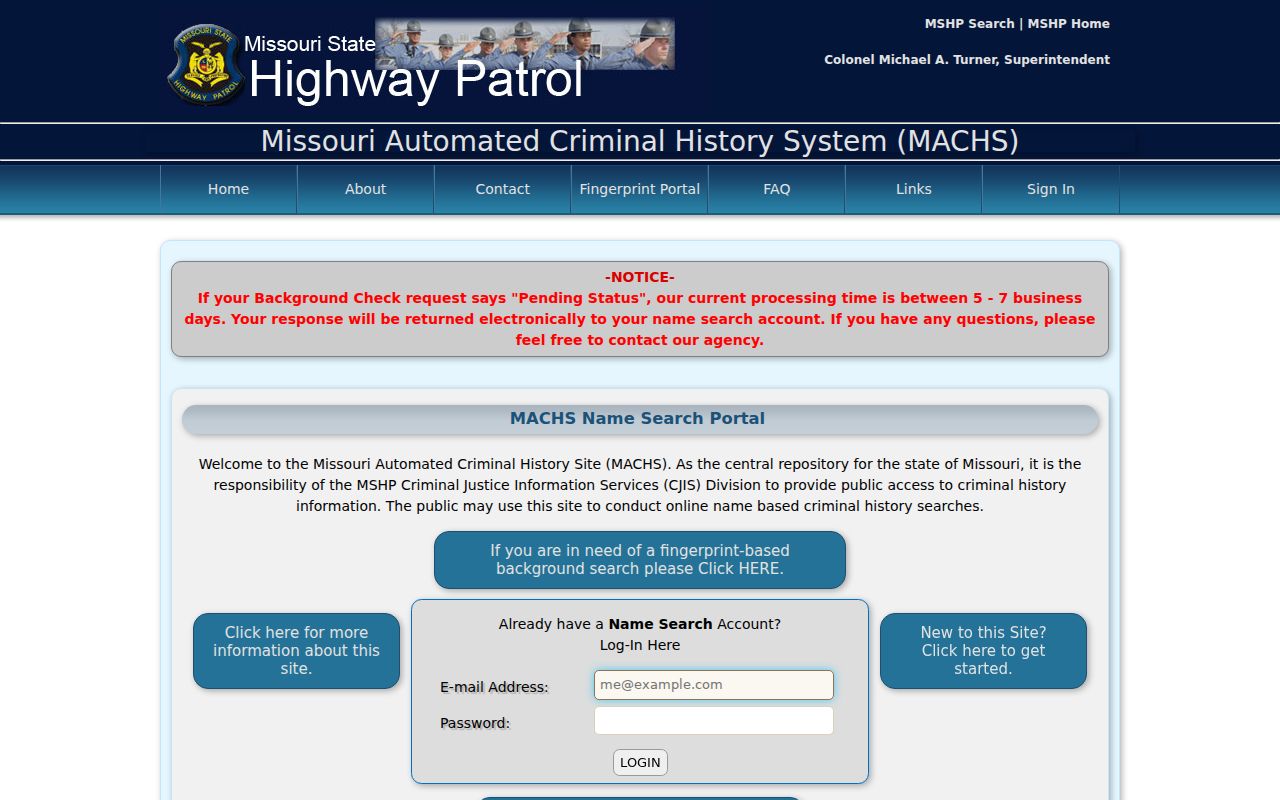
The MACHS interface is the statewide repository route, while Case.net and the Circuit Clerk remain the source for the litigated case file.
The MSHP fee and limitation page also shows why the requested product must match its intended use.
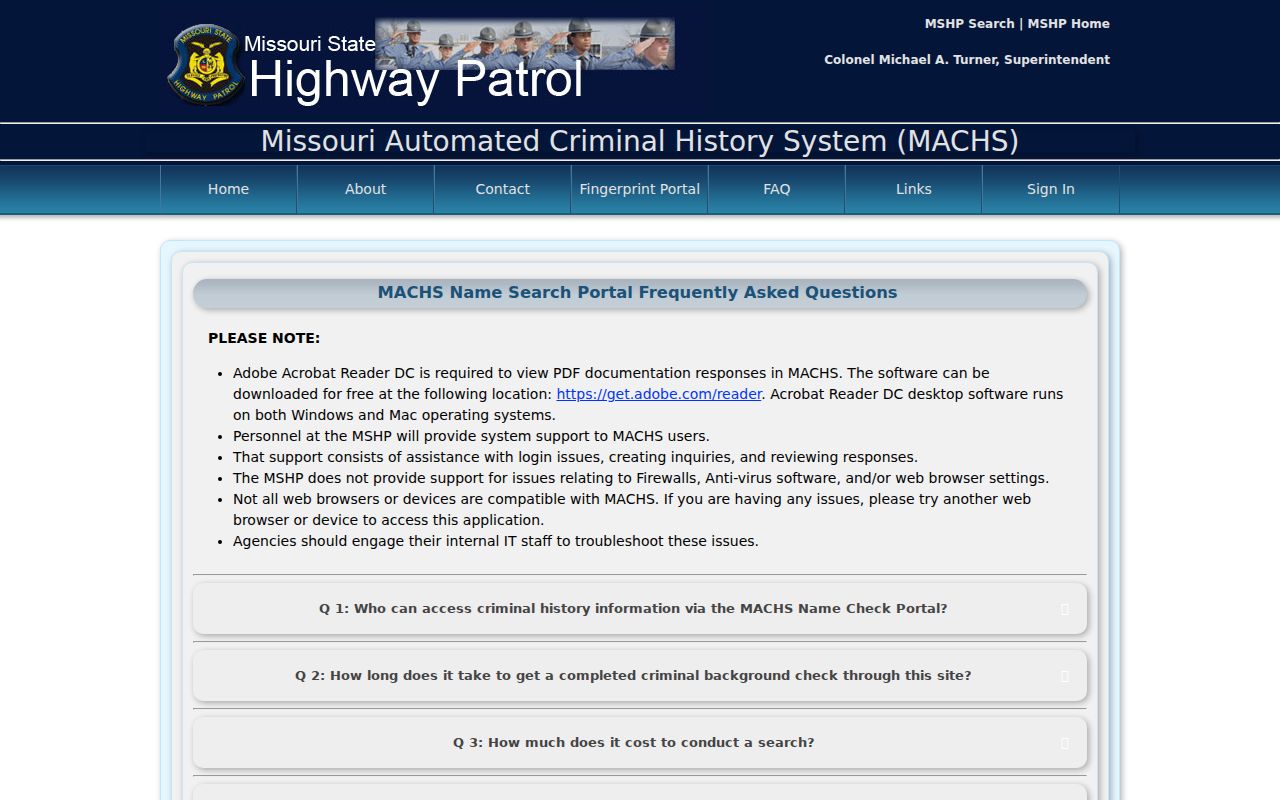
A notarized response authenticates the response process. It does not turn a name search into a fingerprint-confirmed FBI check.
The MSHP criminal-record-check channel explains fingerprint service for authorized purposes and the additional process it requires.
Important: A formal consumer report for employment, housing, credit, or insurance must follow the Fair Credit Reporting Act and other applicable law.
Restricted Missouri Criminal Records
Juvenile court and social records are confidential under section 211.321 except for authorized people and uses. Adoption, mental-health, protected-address, victim, witness, child, and confidential filing-sheet information also receives protection. Sealed and expunged cases may disappear from public name search even though specified agencies retain lawful access. Personal identifiers such as Social Security numbers, complete birth dates, financial account numbers, and confidential addresses are redacted or withheld. A public docket line can remain visible while its attachment is secured.
The Missouri Sex Offender Registry information page describes a separate public-safety system with its own coverage and use limits.
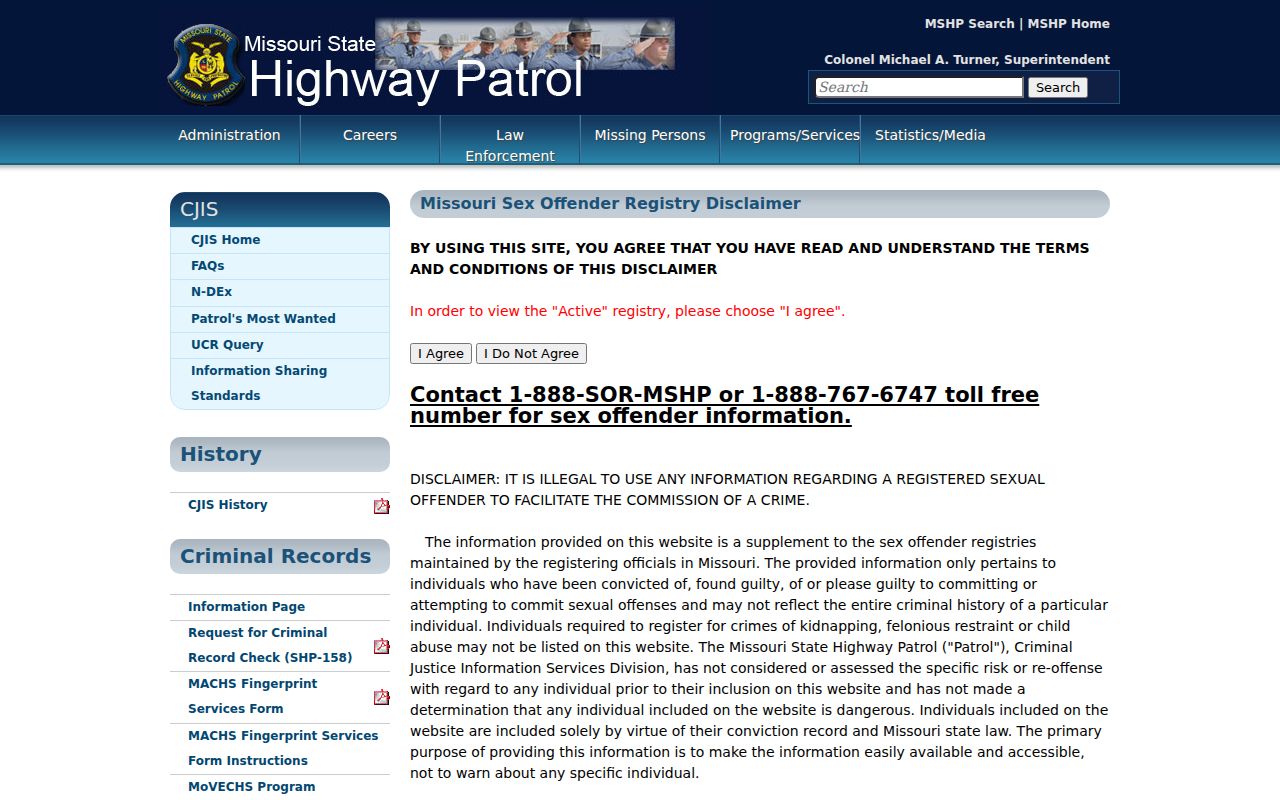
The registry is not a general criminal-case, conviction, or warrant database. Its official detailed search uses separate identity, tier, address, and radius fields. Confirm results with the registering sheriff when accuracy matters.
For certified proof, locate the filing jurisdiction through the directory of Missouri courts. Give the Circuit Clerk the case number, document title, date, desired format, and whether certification is required. Older cases may sit in a legacy database, bound docket, microfilm, storage, or an archives transfer. Absence from Case.net does not certify that no Missouri criminal court record exists.