
How to Search Missouri Court Records
Missouri Case.net is the statewide public case-information service. It searches nonconfidential cases entered in the State Courts Automated Case Management System. The service offers routes for a litigant name, filing date, case number, and scheduled hearings or trials. A complete case number is the strongest key. Name searches work best with the correct spelling, middle name, likely filing place, and case type. Open a result only after comparing its style, court location, filing date, and party roles. Common tabs then show the case header, parties and attorneys, docket entries, charges or judgments, service, and scheduled events.
Case.net is an index and access layer, not a promise that every court document is online. A linked docket description can open a public image when the user's access level permits. A plain entry may have no image, or the image may be limited to a courthouse terminal, an attorney, a party, or court staff. Historical paper files, some municipal matters, sealed cases, and confidential case types may not appear. When the index stops short, contact the Circuit Clerk in the filing jurisdiction. The clerk can check archived systems, microfilm, electronic files, and retained paper records, then quote a plain or certified copy.
- Start with Case.net and select the search route that matches the facts already known.
- Enter the full case number, or use a legal name with a court location and date filter.
- Confirm the case header before relying on a similar name or charge description.
- Review the docket and available document links, then note the exact filing jurisdiction.
- Use the county directory to request a missing or certified document from its official custodian.
Missouri Court Records by Level
Missouri has a unified three-level judiciary. The Circuit Court is the single court of general original jurisdiction. It operates in every county and independent St. Louis City, grouped into 46 judicial circuits. Circuit judges hear general civil and felony work. Associate circuit judges receive many misdemeanors, lower-value civil suits, landlord-tenant matters, small claims, and early felony proceedings. Probate, family, juvenile, treatment, and municipal courts are divisions of Circuit Court, not separate tiers. That structure explains why a local office or division may have a distinct counter while the case remains a Missouri Circuit Court record.
The Missouri Court of Appeals has Eastern, Western, and Southern districts. Most appeals from Circuit Court begin in the geographic district that covers the trial location. The seven-judge Supreme Court of Missouri is the court of last resort and has exclusive appellate authority over specific constitutional categories, state revenue, title to state office, and death-penalty cases. Other matters can reach it by transfer. The full Missouri court system profile explains the jurisdiction and federal courts that sit in the state.
Typical appeal path: Circuit Court division › Missouri Court of Appeals › Supreme Court of Missouri.
| Court | Jurisdiction | Case Types |
|---|---|---|
| Supreme Court of Missouri | Final state review and assigned exclusive appeals | Constitutional questions, state revenue, title to state office, death penalty, transferred cases |
| Missouri Court of Appeals | Three geographic districts | Most appeals from Circuit Court |
| Circuit Court | 46 circuits covering 115 jurisdictions | Felony, civil, family, probate, juvenile, small claims, landlord-tenant |
| Municipal Divisions | City ordinance jurisdiction within Circuit Court | Municipal traffic and ordinance violations |
Types of Missouri Court Records
Missouri court records reflect the division and remedy involved. Civil files may contain a petition, summons, service return, answer, motions, orders, judgment, garnishment, and satisfaction. Criminal files begin when a prosecutor files a complaint, information, or indictment, then track bond, counsel, pleas, hearings, disposition, and sentence. Family assignments hold dissolution, paternity, custody, support, and protection-order proceedings. Probate files cover wills, estates, guardianships, conservatorships, claims, settlements, and distribution. Traffic cases can arise in an associate division under state law or in a municipal division under a city ordinance. Juvenile, adoption, mental-health, and protected-party materials receive stronger limits.
- Criminal records: filed charges, motions, plea or trial result, sentence, and later appeal events.
- Civil records: claims, service, motions, orders, judgments, liens, execution, and satisfaction.
- Family records: dissolution, legal separation, paternity, custody, support, modification, and protection orders.
- Probate records: wills, letters, inventories, claims, accountings, distributions, guardianships, and conservatorships.
- Traffic records: citations, pleas, court dates, dispositions, costs, warrants, and compliance events.
A public docket can coexist with a secured document. For example, a family case may show its filing and judgment while hiding unredacted financial data, children's identifiers, or a protected address. Search the case first, then ask the clerk which public copy can lawfully be supplied.
What Missouri Court Records Show
A Missouri result starts with identity and venue: court, county or city, judicial circuit, division, case number, case type, filing date, judge, status, and disposition date. Party tabs identify plaintiffs, defendants, petitioners, respondents, the state or municipality, lawyers, and represented sides. The docket builds a chronology of pleadings, service, notices, hearings, motions, orders, continuances, judgment, sentence, appeal, and mandate. Criminal tabs can add count, statute, class, offense date, amendment, plea, finding, and sentence. Financial entries may show fines, costs, restitution, bonds, judgments, garnishments, or payments, but an online figure is not always a certified payoff.
| Field | What It Shows |
|---|---|
| Case Number | Assigned identifier that can encode filing year, circuit, type, and sequence. |
| Filing Date | Date the court opened or received the matter. |
| Parties | Named litigants, their roles, and attorneys, subject to security limits. |
| Charges or Claim | Criminal count, statute, ordinance, or the civil relief sought. |
| Disposition | How the case or count ended, such as dismissal, acquittal, conviction, or judgment. |
| Sentence or Judgment | The court's operative outcome, financial award, custody term, probation, or other relief. |
Missouri Statewide Record Systems
Not every record is a court file. The Missouri State Highway Patrol compiles reportable arrest, charge, and disposition data in the state's criminal-history repository. Its paid MACHS name search returns open Missouri criminal history, while authorized fingerprint checks provide stronger identity matching. The Department of Corrections maintains a separate Offender Search for current and former custody or supervision. County jail bookings are not replaced by that tool. A person held before trial may appear only on a sheriff roster, while a sentenced person can later appear in the DOC system after transfer and intake.
The Department of Revenue holds driver records with reportable convictions, points, status, and license actions. That file differs from the traffic case kept by a Circuit or municipal clerk. The Bureau of Vital Records maintains a statewide marriage and divorce registry beginning July 1, 1948 and issues certified statements. The original marriage certificate remains with the Recorder of Deeds, and the divorce decree remains with the Circuit Clerk. Missouri also provides a Sex Offender Registry and uses VINE for custody notifications. The Missouri inmate records page keeps jail, prison, and notification systems distinct.
| System | What It Holds | Run By |
|---|---|---|
| DOC Offender Search | State custody, sentence, location, and supervision data | Missouri Department of Corrections |
| MACHS Name Search | Open Missouri criminal-history records | Missouri State Highway Patrol |
| DOR Driver Records | Driving history, points, status, and license actions | Missouri Department of Revenue |
| Bureau of Vital Records | State marriage and divorce registry statements | Missouri DHSS |
Public Access to Missouri Court Records
Missouri access depends on the custodian and the kind of record. Court Operating Rule 2 and judiciary security rules govern court files, remote display, redaction, and role-based access. Chapter 610 of the Revised Statutes, commonly called the Sunshine Law, applies most directly to executive and local governmental records, including releasable agency, sheriff, and administrative material. Section 610.023 requires each public body to identify a custodian and act on an open-record request as soon as possible. If access is not immediate, the custodian must explain the cause and provide the earliest time and place for access. That is not a fixed promise that every record will be produced within three days.
The Missouri Attorney General's Sunshine Law program explains how to identify the correct custodian and frame a focused request.
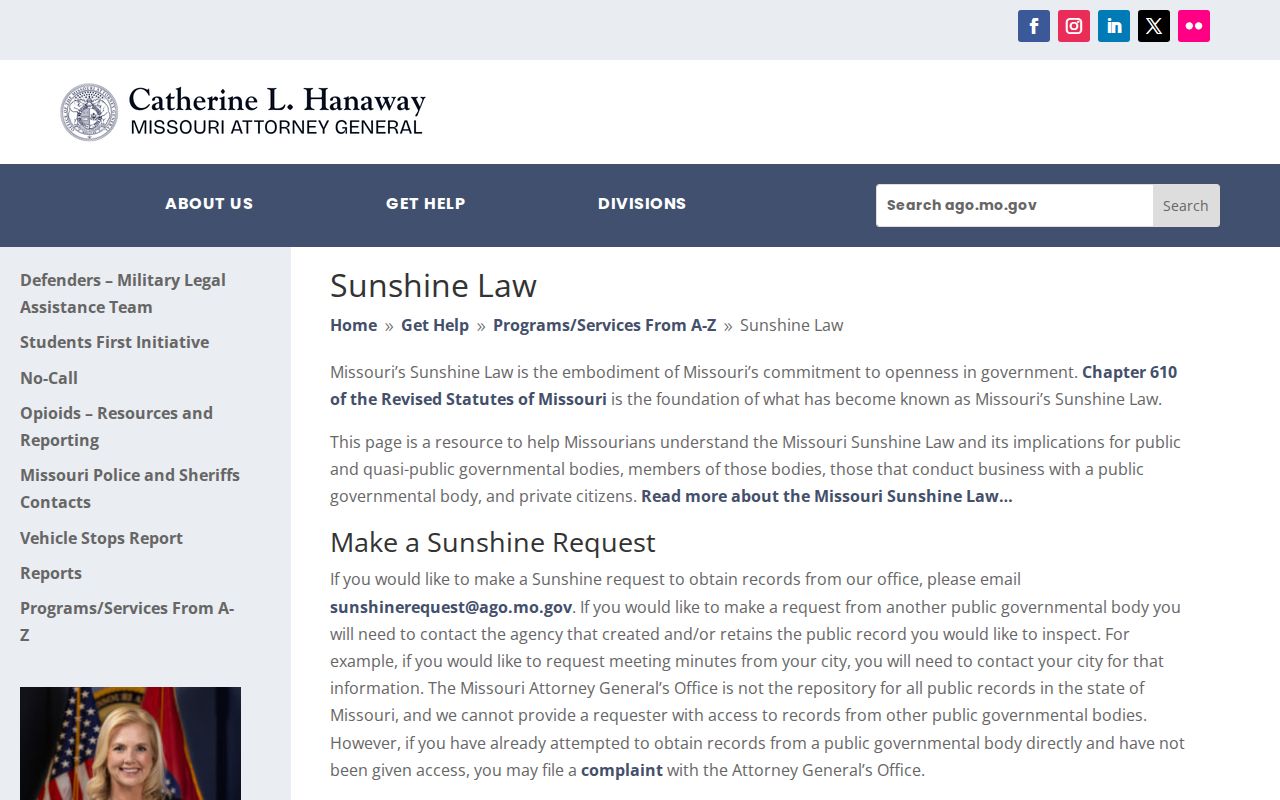
The official program is a guidance and complaint route, not a central warehouse for Missouri court records. A request should still go to the office that created or keeps the specific file.
Missouri's Sunshine Law definitions help separate public records, public governmental bodies, and related terms.
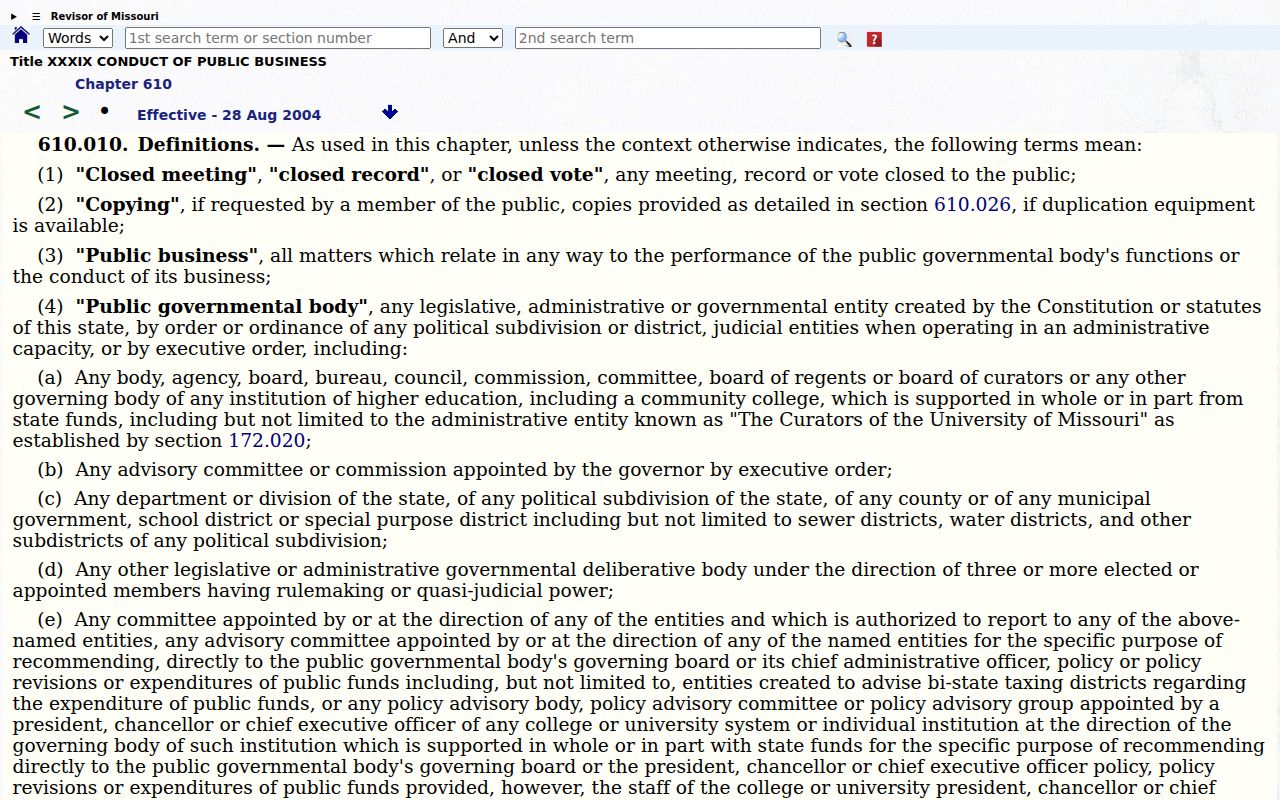
The statutory text should be read with the court rules and any sealing order because the same public-access label does not create identical access to a court pleading, police investigation, booking sheet, and state criminal history.
Key Statutes:
Section 610.023, RSMo: identifies custodian duties, response rules, and authorized research and copy charges.
Section 610.100, RSMo: distinguishes open arrest and incident facts from investigative material that may be closed.
Section 610.120, RSMo: limits general public access to closed criminal records while preserving listed authorized uses.
Section 610.140, RSMo: provides the petition process for expunging qualifying Missouri records.
Restricted Missouri Court Records
A visible case does not make every attachment public. Missouri protects juvenile court and social records except for access authorized by the Juvenile Code. Adoption files, mental-health evaluations, treatment data, unredacted financial records, confidential addresses, and protected victim or child information also receive limits. Public images should omit Social Security numbers, full birth dates, account numbers, and other secured identifiers. A protected person may not appear in a public name search even when a user with the case number can see a limited docket. The Circuit Clerk can explain the public access level, but a judge may be required to decide a disputed request.
Expungement under section 610.140 is a court process for qualifying Missouri arrest, plea, trial, and conviction records. Eligibility depends on the offense, waiting rules, sentence completion, later conduct, outstanding obligations, and statutory exclusions. A successful order closes records under section 610.120 and directs listed record holders to act. Closed does not always mean destroyed. The person, criminal-justice agencies, and specified licensing or other users can retain access for defined purposes. Public searches should never be used to infer that a missing result proves the event never occurred.
Sealed warrants and active investigative material pose a different issue. An unexecuted search warrant or supporting affidavit may stay sealed to protect the investigation. Ask the issuing court for the precise public item after execution or unsealing rather than treating a statewide criminal-history response as a warrant file.
Find Court Records by County in Missouri
Certified Missouri court records come from the filing Circuit Clerk, Probate Division, municipal clerk, or appellate clerk. Local jail and warrant facts come from sheriffs and issuing courts, while original marriage licenses come from Recorders of Deeds. The six featured jurisdictions represent the state's largest metro court systems. Missouri has 115 local court jurisdictions because independent St. Louis City is separate from St. Louis County. Check the event location carefully before choosing between them.
St. Louis County
Clayton · Missouri's largest county and an extensive metro court system
Jackson County
Independence · Major Kansas City metro circuit and municipal venues
St. Charles County
St. Charles · Fast-growing St. Louis metro jurisdiction
Greene County
Springfield · Southwest Missouri's largest metro county
Clay County
Liberty · Kansas City northland circuit and municipal activity
Jefferson County
Hillsboro · Populous St. Louis metro court jurisdiction
Browse the full directory of all 115 Missouri jurisdictions to open the court records site for any county or St. Louis City.
Missouri Court Records Fees
There is no single statewide price for every Missouri court copy or filing. Local rules show plain-copy prices ranging from 25 cents to $1 per page, and one official example adds $1.50 for a certified seal. Filing deposits can combine state components with local charges, automation fees, service, publication, postage, card convenience costs, and archive research. Ask the filing clerk for a written estimate and state whether a plain, certified, authenticated, or exemplified copy is needed. Inspection may cost less when no copy is required. A judge decides a properly filed application to proceed as a poor person; submitting the form does not guarantee a waiver.
| Item | Amount |
|---|---|
| Local plain court copy | Official examples range from $0.25 to $1 per page |
| Certified seal | One official local example adds $1.50 plus page charges |
| MACHS name search | $15; optional notarization is $5 more |
| DOR driver record | $2.82; office and fax charges can apply |
| DHSS marriage or divorce statement | $15 nonrefundable search fee per copy |
Interpret Missouri Court Records
Read each Missouri case from its header through the latest entry. A charge is an accusation, not a conviction. Each criminal count may be pending, amended, dismissed, resolved by guilty plea, found guilty after trial, or end in acquittal. A nolle prosequi means the prosecutor chose not to proceed at that time. It is not an acquittal. A suspended imposition of sentence, often shown as SIS, suspends imposition while probation is completed. A suspended execution of sentence, or SES, means the court imposed a sentence but suspended its execution during probation. Those terms carry effects that depend on the record and legal context.
Case numbers often combine a two-digit year, circuit identifier, two-letter case-type code, and sequence. CR commonly marks criminal, CV civil, SC small claims, DR dissolution, PR probate, JU juvenile, and TR traffic, but appellate, municipal, legacy, and converted files can differ. Copy the number exactly from the notice or pleading. The docket is the chronological index. The actual complaint, motion, order, judgment, or exhibit is a separate document and may have a different access level.
Accuracy of Missouri Court Records
Missouri systems update on different schedules. A clerk enters court events, a sheriff updates booking and release, MSHP receives reportable criminal data, DOC calculates custody and supervision fields, DOR receives traffic convictions, and DHSS receives marriage or divorce reports. A mismatch should be corrected first at the originating source. For a litigated outcome, the signed or certified court order carries more weight than an agency summary. For live custody, the holding jail or prison has the current status. Name-only results are candidates, so compare middle name, date of birth where lawfully available, filing location, cause number, and offense date before treating a result as a match.
Note: Confirm a Missouri court result with the filing clerk before using it as proof of status, judgment, sentence, or payment.
Missouri Court Records FAQ
Is Case.net a complete court file?
No. Case.net is a broad statewide index with public docket information and eligible document links. Some public documents are available only at a courthouse terminal or from the Circuit Clerk. Older paper files, confidential matters, protected names, and some municipal records may be absent. A certified copy must come from the clerk that holds the official file.
Why can a case number work when a name does not?
Missouri protects some party roles and names from public search. A victim, child, protected person, or other secured role may not be discoverable by name even when a limited case header is available through its number. Spelling, aliases, conversion of an old file, and filing location also affect name results. Use the exact case number when available.
Are court records and criminal histories the same?
No. The Circuit Clerk's file documents one prosecution and contains pleadings, motions, hearings, dispositions, and sentence. MSHP compiles reportable activity across Missouri in a criminal-history response. A MACHS name search is limited to open Missouri data and does not include closed Missouri or FBI records. Fingerprints provide stronger identity confirmation when an authorized purpose requires it.
Where do Missouri marriage and divorce records come from?
The Recorder of Deeds that issued the license holds the original marriage record. The Circuit Clerk that granted dissolution holds the divorce case and signed decree. The Bureau of Vital Records maintains a central registry from July 1, 1948 and issues certified statements. A state statement is not the original marriage certificate or divorce decree.
Does an expungement erase every record?
Not in every context. A granted Missouri expungement closes qualifying records from ordinary public access and directs named repositories to act. Section 610.120 still allows access by the subject and specified criminal-justice, licensing, and other authorized users. Eligibility and disclosure effects depend on current law and the particular record.
How do I get an old Missouri case?
Search Case.net, then contact the Circuit Clerk in the filing jurisdiction. Give former names, a narrow year range, case type, and any known number. Ask whether the index or file is in a legacy database, bound docket, microfilm, off-site storage, or an archive transfer. An empty online result is not a formal no-record finding.